

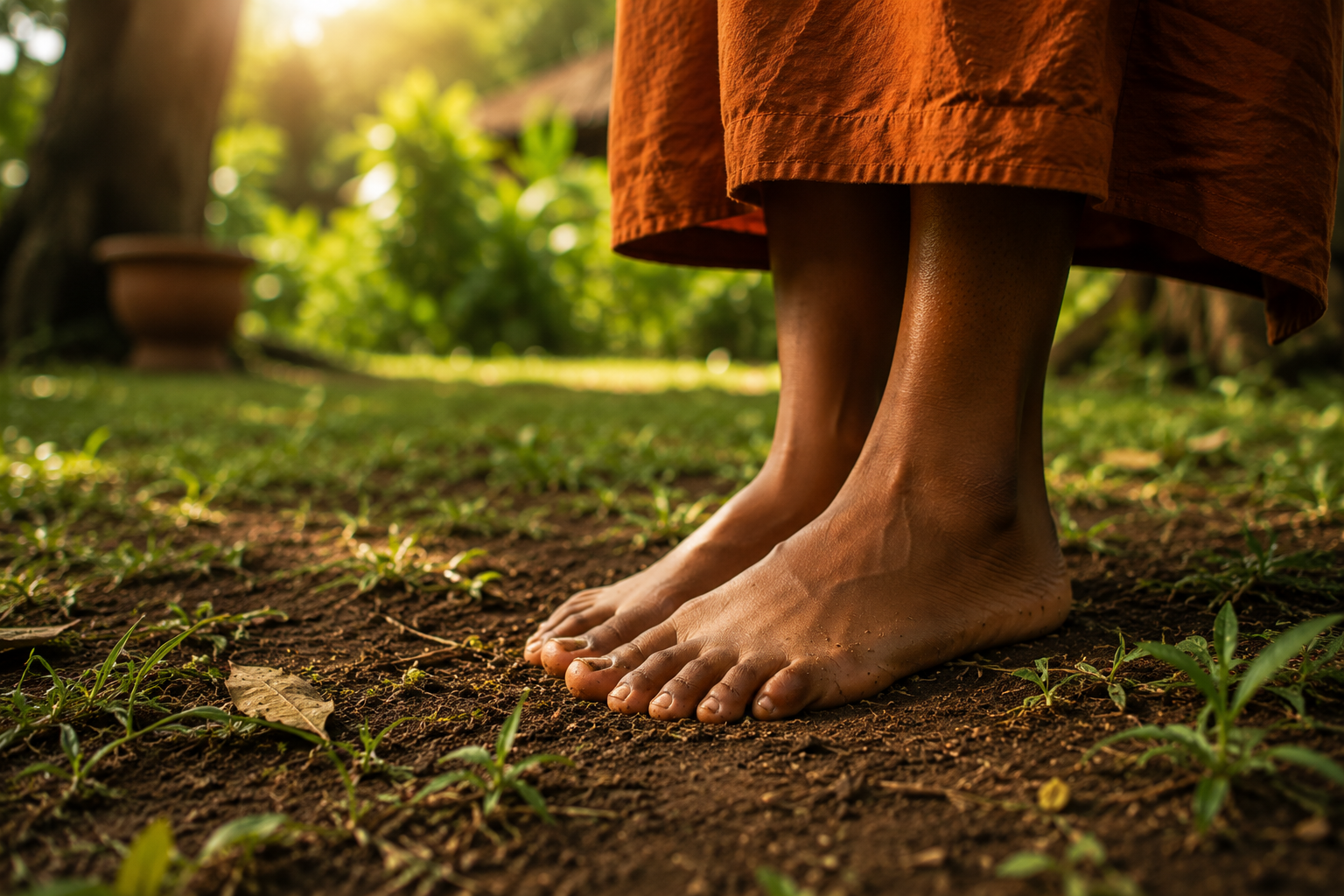
People rarely look down unless they have dropped something.
A key. A coin. A phone slipping face-down onto the pavement. Only then does the ground receive attention. Only then does the body fold towards what has been beneath it all along.
Most of the time, we move as though the world begins at eye level. Faces. Screens. Windows. Traffic lights. Shelves. Mirrors. The horizon of a day is usually built from things in front of us, not underneath us.
And yet every life begins with being held.
Before ambition. Before language. Before belief. Before the first plan, the first success, the first wound we learn to hide. There is a surface receiving the body. A floor. A bed. A lap. A road. A field. A patch of earth that does not ask to be noticed before doing its work.
The things that hold us up are almost always the things we stop seeing.
Field note: watch someone remove their shoes after a long day.
The gesture is rarely dramatic. A hand against the wall. One foot lifting behind the other. A small collapse of posture as the body comes down from whatever version of itself it had been performing outside. The shoulders loosen before the person realises they have exhaled.
There is a reason people speak of feeling grounded when they mean feeling real again. The metaphor remembers what the schedule forgets. Something in the body understands that presence is not only mental. It has weight. It has pressure. It has contact.
Field note: modern life is full of surfaces designed to prevent direct contact.
Pavement. Carpet. laminate. escalators. platforms. lift floors. office tiles cleaned until they reveal nothing of where they came from. We cross the earth all day without touching it. We travel over it, build on it, price it, fence it, insure it, inherit it, sell it, name it after people who did not make it.
Then we wonder why we feel suspended.
This is not nostalgia for a simpler life. Simpler lives were not simple to the people who lived them. The field was labour. The soil could disappoint. Rain could fail. The ground that gave food also received the dead. No serious tradition has ever treated the earth as sentimental decoration.
But perhaps that is exactly the point. Reverence was never the same as romance. It was attention paid to dependence.
To be grounded is not to feel calm. It is to remember what is carrying you.
Field note: people notice foundations only when something cracks.
A house shifts. A friendship goes quiet. A body refuses its usual obedience. A parent ages suddenly. A trusted system fails in public. What had seemed reliable becomes visible through its weakness, and we realise how much of our confidence depended on something we had stopped thanking.
This pattern repeats everywhere. Sleep is invisible until exhaustion speaks. Health is background until pain becomes fluent. Trust is assumed until suspicion enters the room. The person who always remembers becomes noticeable the first time they forget.
Support has this strange fate: when it is doing its job well, it disappears.
Centuries ago, the Akan had already recognised this. They gave the recognition a sentence: Asase Ye Duru. The earth has weight.
Not weight as burden. Weight as substance. Presence. Consequence. The kind of heaviness that belongs to what cannot be treated lightly. The earth carries farms, homes, bodies, ceremonies, arguments, inheritance, footsteps, hunger, harvest, memory. It carries the living without applause and receives the dead without complaint.
In Akan thought, the earth is not an object beneath human life. She is Asase Yaa: a feminine divine presence, immediate and underfoot. The sacred is not only above, distant and luminous. It is also below, dark and fertile, close enough to stain the palm.
The sky may invite wonder. The earth asks for relationship.
What carries life should not have to break before it becomes visible.
Field note: every culture reveals itself by what it allows to rest.
Among the Akan, there were days when the land was not farmed. The earth was allowed her own pause. This is a difficult idea for an age that respects almost nothing it cannot extract from. Rest becomes laziness. Limits become inefficiency. The refusal to take more becomes a failure of ambition.
But a rested thing can continue giving. A depleted thing eventually teaches by withholding.
This is true of soil. It is also true of people.
There are mothers who become treated like weather: always there, often complained about, rarely understood as the condition that makes the household possible. There are friends who quietly hold the emotional infrastructure of a group. There are elders whose wisdom is ignored because it arrives without novelty. There are workers whose labour is noticed only when the work is not done.
The earth becomes a teacher because she reveals a human habit. We undervalue what is constant. We confuse availability with insignificance. We stand on something every day and call it ordinary because it has never made us beg for its presence.
Asase Ye Duru corrects this quietly. It says: do not mistake silence for lightness. Do not mistake abundance for permission. Do not mistake what holds you for something beneath consideration.
Some things are sacred not because they are rare, but because everything else depends on them.
Field note: the ungrounded person often tries to solve a physical disconnection with mental speed.
More plans. More tabs. More explanations. More ambition applied to the feeling of being scattered. They become fluent in optimisation and strangely unfamiliar with the place where they live. They can describe their goals in detail but not the trees on their street. They know the weather as an app notification before they know it as air on skin.
This is one of the private griefs of modern life: to be connected to everyone and located nowhere. To have a thousand forms of contact and very little belonging. To live above the ground, inside the head, through glass, by appointment, under instruction from devices that do not know the difference between urgency and importance.
The cure is not always dramatic. Sometimes it is embarrassingly literal.
Go outside. Learn the name of one tree. Notice where rain gathers. Touch soil without making a metaphor of it. Know where your food comes from when you can. Let a place become more than an address. Return often enough that the return begins to recognise you.
None of this makes a person pure. It simply restores scale. The self becomes less frantic when it remembers it is not the largest thing in the room.
The earth is heavier than all the children of the world. The old saying is not an insult to human importance. It is a correction of human inflation. Whatever we build, chase, fear, defend and become, we remain carried by something older than our names.
There is mercy in that.
A life becomes steadier when it remembers it is supported by more than its own effort.
Field note: the ground is also an archive.
Every place has absorbed more than it says. Feet before yours. Work before yours. Grief before yours. Seeds planted by hands whose names may no longer be spoken. Roads worn into shape by repeated need. Homes built from decisions made before anyone asked what you wanted from life.
To stand somewhere is never only to occupy space. It is to arrive late into a story already underway.
This is why the earth carries memory so naturally. The dead are returned to it. The living are fed from it. The past is not gone in the way modern language likes to imagine. It is underfoot, incorporated, feeding the roots of things we mistake for new.
A person who knows this walks differently. Not necessarily slower, though perhaps that too. They walk with some awareness that the world is not beginning with them. They inherit. They depend. They borrow. They will return.
And perhaps this is the deepest weight of Asase Ye Duru. Not ecological guilt. Not decorative reverence. A way of placing the self back into right proportion.
You are not nothing.
You are also not everything.
Between those two truths, a more grounded life becomes possible.
Tomorrow, someone will look down because they have dropped something. A key, perhaps. A coin. A phone on the pavement. For a moment, the body will bend towards the ground and notice what has been there the entire time.
Then it may straighten again.
But perhaps not quite as quickly.
Sit With This
What has been carrying you that you have stopped seeing?
A place you return to.
A person whose steadiness became ordinary.
A ground beneath your life that deserves your attention again.
Leave it in the comments below.
