

The pianist begins with scales.
Not the song. Not the part people recognise. Not the few dazzling minutes when the room falls quiet and everyone suddenly understands what years of practice can become. Scales. Again. The same small climb of notes, up and down, one hand, then the other, the body learning before the audience exists.
There is nothing impressive about it from the outside. No one applauds a warm-up. No one writes about the morning when the left hand finally became less clumsy. No one sees the patient correction of one phrase that will later sound effortless because effort has been hidden inside repetition.
But the performance is already being decided there.
The decisive moment rarely begins where people start watching.
The grandmother waters the garden before the heat arrives.
Every morning, the same gesture. The metal can. The slow tilt of the wrist. Water darkening the soil around stems that barely seem to change from one day to the next. She does not look like a strategist. She looks like someone tending what would otherwise be forgotten.
Months later, visitors praise the colour of the place. They admire the shade, the fruit, the green insistence of life around the house. They say she has a gift. They do not mean to be wrong. But gifts, like gardens, are often made from attention repeated until it begins to look natural.
Elsewhere, a founder deletes another version of the thing that was supposed to work.
The first design was clever and unusable. The second looked better and solved less. The third almost worked, which somehow made its failure more irritating. So the file is renamed, archived, opened again. Another small adjustment. Another private humiliation. Another lesson disguised as a setback.
From the outside, nothing is happening. No launch. No article. No sudden upward line on a chart. Just someone becoming harder to fool by their own first idea.
What looks like delay may be intelligence refusing to arrive too early.
A couple make tea after an argument.
Not because everything is solved. It is not. One of them is still hurt. One of them is still rehearsing a sentence they have decided, wisely, not to say yet. But the kettle is filled. Two cups are taken down. Someone asks, more gently than they feel, whether the other wants sugar.
Years later, people will call them lucky. They will speak of chemistry, compatibility, the rare blessing of finding someone who fits. They will not see the hundreds of almost invisible choices by which two people protected the room before it became a home. The apology given before pride became architecture. The joke offered at the right time. The difficult conversation not avoided. The tea made when silence could have hardened.
Love, too, has a long game.
A teacher reads the essay twice before writing in the margin.
The first reading finds the errors. The second finds the student. Under the awkward sentences, there is something trying to think. A question not fully formed. A confidence almost frightened of itself. The teacher could mark the surface and move on. Instead, she writes one sentence that sends the student back to the work with a different posture: There is something here. Follow it further.
It is a small move. It may never be remembered. Or it may be the sentence a person carries for years without knowing when it became part of them.
Attention is often the first form of strategy.
At first, these lives seem unrelated.
Music. Gardening. Work. Marriage. Teaching. Different rooms, different ages, different kinds of labour. But look again and a pattern begins to show itself. In every scene, the visible outcome is being shaped before it becomes visible. A move is made quietly. Then another. A future is prepared while it still looks like nothing has happened.
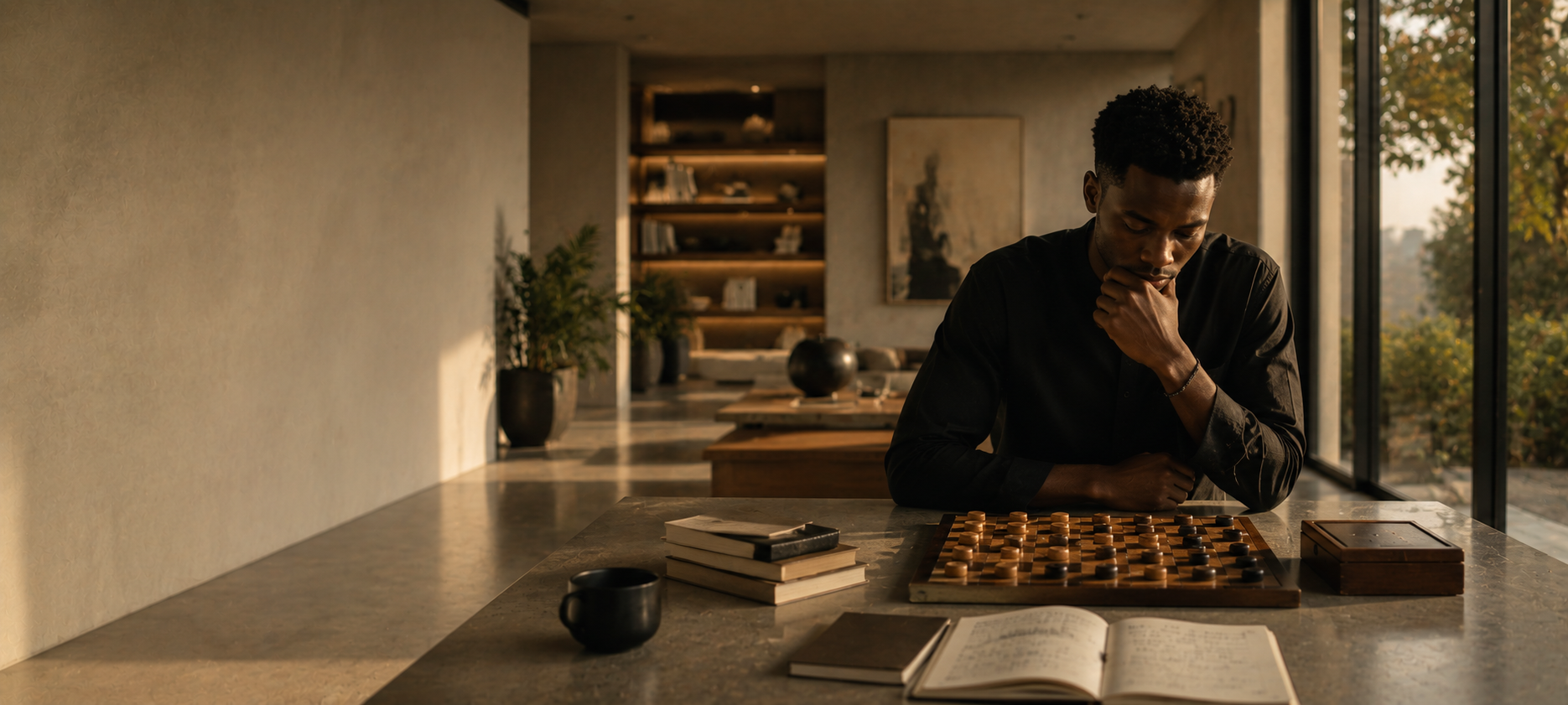
Centuries ago, the Akan recognised this quality of mind and carved it into the image of a board game. Dame-Dame. A game of placement, patience, accumulated attention. A player does not win by one dramatic move alone. The final move only reveals the intelligence of all the earlier ones.
The board is shaped slowly. A piece here. A piece there. A small choice that seems harmless until it makes another choice possible, which then closes one route and opens another. The inexperienced player watches the present move. The deeper player watches the future forming around it.
This is why genuine intelligence often looks unimpressive at first. It is not always quick. It is not always loud. It does not always rush to display itself. Sometimes the person who understands most appears simply to be waiting, listening, placing one thing carefully beside another.
The board is won by the person who has been seeing the pattern before the pattern needed to announce itself.
We tend to admire the final move because it is the one that gives the story a shape.
The decisive conversation. The successful launch. The performance. The harvest. The relationship that feels steady. The answer that seems to arrive with perfect timing. But timing is rarely magic. More often, it is preparation becoming visible at last.
The person who asks one more question in a meeting is not being difficult. They are placing a piece. The friend who remembers what you said weeks ago is not simply thoughtful. They have been holding the board in mind. The leader who pauses before deciding is not slow by accident. They are checking the position of pieces other people have stopped seeing.
Dame-Dame is not a symbol of cleverness in the shallow sense. Cleverness wants the satisfying move. Wisdom wants the right position. Cleverness enjoys surprise. Strategy understands consequence. Cleverness may win the moment. Dame-Dame is interested in the shape of the board after the moment has passed.
This matters because most of what becomes meaningful in a life is built before it can be praised. Trust is not created by one grand act of loyalty, but by many small occasions on which betrayal would have been easier. Skill is not created by talent alone, but by the unglamorous return to what still resists you. Character is not created in the crisis, though crisis reveals it. Character is placed beforehand, move by move, in ordinary conditions.
The move that changes everything is usually made possible by moves no one clapped for.
There is comfort in this, though perhaps not the easy kind.
It means the quiet work is not nothing. The small repetitions, the questions, the returning, the drafts, the habits, the conversations you stayed in after the obvious point had been made. These are not wasted moves simply because they have not yet produced a result dramatic enough to photograph.
It also means neglect compounds. Avoidance has a strategy too. So does resentment. So does inattention. The board is always forming, whether or not we are watching. A relationship can be lost by many small withdrawals before anyone admits it is gone. A skill can become distant through repeated refusal to practise. A life can be shaped by default as surely as by intention.
This is the seriousness beneath Dame-Dame. It is not asking whether you are brilliant. It is asking what your repeated attention is building.
Look at your life as a board for a moment. Not as a judgement. As an observation.
Where have you been placing pieces for years without acknowledging the shape they have begun to make? What have you been learning slowly, in fragments, through mistakes and returns and questions that would not leave you alone? What future are your ordinary choices already preparing?
Perhaps you are further along than you think.
Not finished. Not guaranteed. But no longer at the beginning you keep imagining yourself to be.
The pianist is still practising scales. The grandmother is still watering before the heat arrives. The founder is still deleting the version that nearly worked. The couple are still making tea after difficult sentences. The teacher is still writing one careful line in the margin.
None of them knows, this morning, whether today’s move will be the one that matters.
They make it anyway.
Which is how every remarkable board is built.
Sit With This
What board have you been building without noticing its shape?
The question you keep returning to.
The skill becoming quiet muscle.
The future your small moves are already preparing.
Leave it in the comments below.
