

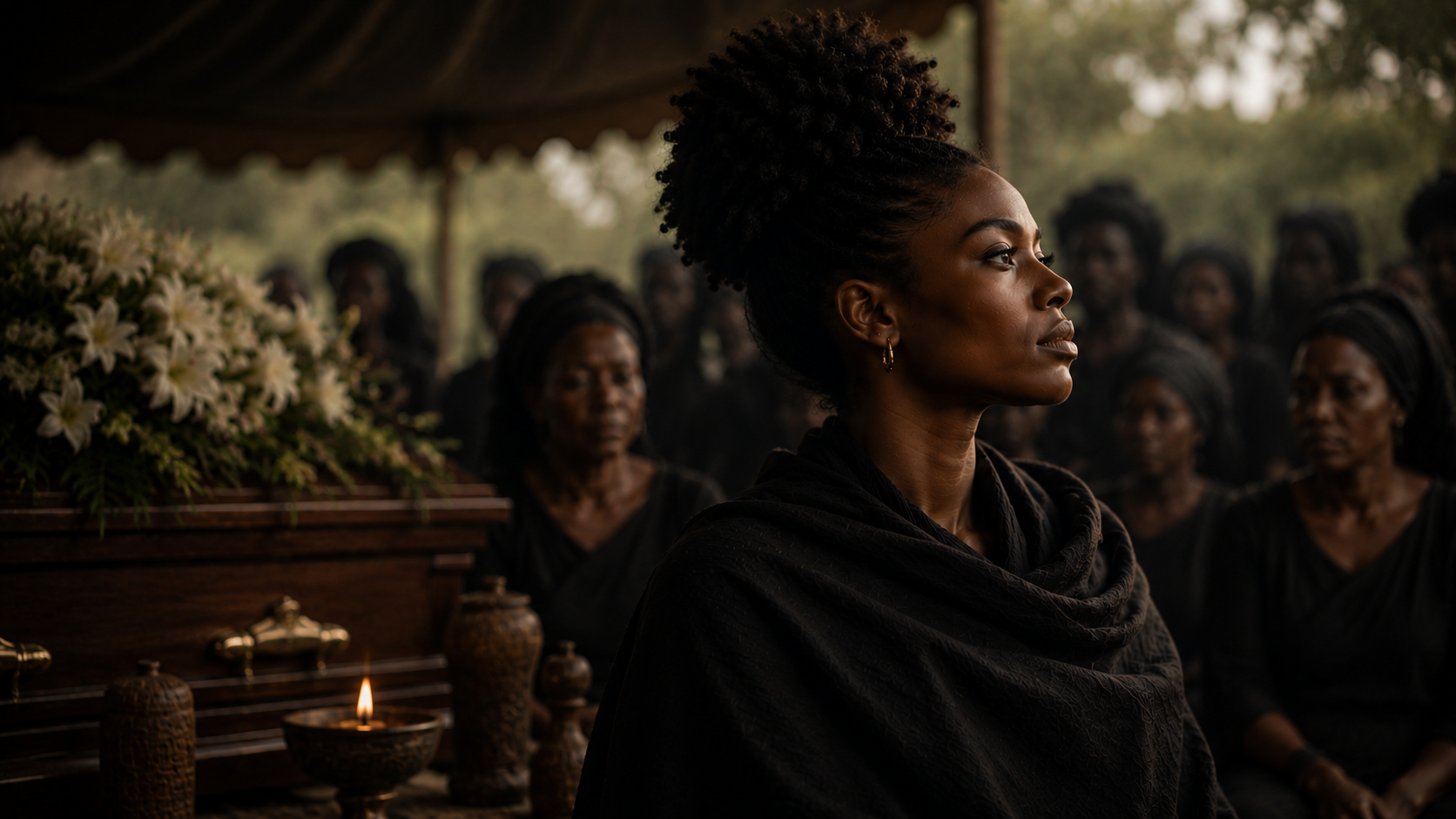
At eight, death belongs to old people.
It lives in lowered voices, black clothes, adults entering rooms with faces already arranged. It is something that happens somewhere else, to someone else, after a very long time. The child notices the seriousness but not the meaning. They know only that people speak differently when death is nearby, as though the air itself has become breakable.
At eight, life feels endless because everything important has happened already and somehow keeps happening again. Breakfast. School. Rain against windows. Someone calling your name from another room. The body is too busy growing to imagine its own ending.
There are funerals, perhaps. A grandparent. A neighbour. A distant uncle whose name everyone knows except you. You are told to be quiet, to greet properly, to sit still. People cry, then eat, then laugh softly in corners, and this confuses you most of all.
If death is so terrible, how can jollof rice still be served?
The first mercy of childhood is not knowing that time is already moving.
At nineteen, death belongs to the reckless.
It belongs to headlines, late-night phone calls, sharp bends in roads, other people’s families. It is tragic, yes, but still somehow exceptional. A mistake in the pattern. A terrible interruption of what should have continued.
You begin to understand that people can disappear, but not yet that you are one of them. Your own life feels too immediate to be fragile. There are plans to make, messages to answer, rooms to enter as though arrival itself were a form of permanence. You know, in theory, that everybody dies. But theory has no body. It does not sit beside you. It does not look like your own hand resting on a table.
At nineteen, mortality is a fact you can admire for its seriousness without letting it change your calendar.
You say things like “one day” and “eventually” and “when I’m older” as though time were a country you can enter when ready. You postpone apologies because there will be other evenings. You delay tenderness because people will understand. You save your real self for a future that seems patient enough to wait for you.
Then one day someone your age dies, or someone close enough to your age that the excuse fails. For a few days, everything becomes bright with meaning. You message people. You say what should be said. You promise yourself not to waste time.
Then life, merciful and dangerous, becomes ordinary again.
Youth often knows life is short and still behaves as though time were an unlimited material.
At thirty-four, death becomes administrative.
Forms. Passwords. Hospital corridors. Insurance documents. A parent’s medication written on paper in someone else’s careful handwriting. A friend tells you about a diagnosis over dinner, and the waiter arrives too soon with the bill. You discover that the profound and the practical are not opposites. They sit beside each other constantly.
You still have ambitions, but they now share space with errands. Your dreams are no longer abstract. They have rent, school fees, ageing parents, unread emails, blood tests, calendars full of things you chose and things that chose you. Life is not less beautiful. It is more crowded.
This is often when the ladder first becomes visible.
Not because you are near the top. You may not be. But because you begin to feel the rungs beneath you. Birthdays no longer simply arrive. They measure. Children become older than you remember being. Parents become people you worry about. The body starts sending small reports from the future. Sleep is no longer optional without consequence. Recovery takes longer than pride expected.
Centuries ago, the Akan had already given this recognition a sentence: Owuo atwedee, obiara beka ho. The ladder of death; everyone will climb it.
It sounds severe only if you hear it from far away. Up close, it is strangely merciful. It does not say some lives are marked and others are spared. It does not flatter wealth, beauty, talent, title or youth. It says everyone. The chief and the child. The celebrated and the unknown. The person building a name and the person trying simply to get through the week.
Everyone will climb.
The ladder is not waiting at the end of life. Life itself is the ladder.
At forty-seven, you begin counting differently.
Not always. Not morbidly. But privately. You know how old your parents were when certain things happened. You realise there are books you will never read, cities you may never visit, versions of yourself that will not have time to become real. This does not make life smaller. It makes it more exact.
You start to understand the difference between what is urgent and what merely makes noise. Some arguments become too expensive. Some ambitions lose their shine because you finally see the life they would require of you. You are less impressed by being busy. You become suspicious of anything that consumes your days without deepening them.
The Akan did not place the symbol of the ladder on funeral cloth to make the living despair. They placed it there so the living would remember how to live among the facts. A funeral gathers people around an ending, but it also returns each person to their own unfinishedness. Someone has reached the top rung. Everyone else is still standing somewhere below, holding plates, greeting cousins, checking phones, pretending not to feel the arithmetic.
This is not cruelty. It is orientation.
Mortality gives scale to grievance. It does not make every wound small. Some wrongs remain real. Some losses cannot be made elegant by philosophy. But the ladder asks a ruthless and tender question: how much of your remaining life do you want to give this?
Sometimes the answer is: enough to seek justice. Enough to tell the truth. Enough to protect what must not be repeated.
Sometimes the answer is: no more.
To remember death honestly is not to love life less. It is to stop spending life as though it were impossible to run out.
At sixty-two, the past becomes populated differently.
More of the dead are people you knew by voice. You remember how someone laughed, the way they stood at the gate, the strange phrases they used, the foods they preferred, the chair that seemed to belong to their body. They are not abstractions. They are rooms inside memory.
You understand now why people at funerals laugh. Not because death is light, but because love is not obedient enough to remain solemn. Memory arrives as a joke, a song, a correction, a story someone has told badly and someone else must improve. The dead are gone and not gone. Absence becomes crowded.
In Akan understanding, death is not an erasure. It is a transition into another form of presence, joining those who came before and continuing to shape those who remain. This does not remove grief. Nothing serious does. But it means the ladder does not lead into meaninglessness. It leads beyond the particular form in which a person was known.
Still, the proverb does not soften the word. Owuo. Death. Plainly named. No decorative mist. No careful substitute placed over the mouth of reality. There is dignity in that directness. Some truths grow heavier when we dress them too lightly.
The ladder teaches directness because directness protects attention. If you cannot say what is true, you cannot organise your life around it. You can only drift around its edges, making choices as though the unsaid thing were not already shaping the room.
A plain word can become a mercy when it returns us to the real size of our lives.
At seventy-nine, ordinary things become astonishingly specific.
A cup warm in both hands. Morning light on a wall. The sound of someone washing dishes in another room. A child leaning against your knee without knowing this is the kind of moment adults spend whole lives trying to return to. The same world has not become more beautiful. You have become less casual with it.
This is one of mortality’s stranger gifts. It does not add anything to the scene. It removes the illusion that the scene is guaranteed.
By then, if one is fortunate, ambition has changed its clothes. It may still exist, but it is no longer so loud. The question is less “What can I become?” and more “What have I loved well?” Not perfectly. Perfect love is usually imagined by people not yet required to practise it daily. But well enough. Honestly enough. With enough presence that someone, later, might remember your voice without bitterness.
The ladder of death is the great leveller, but it is also the great clarifier. It strips away the fantasy of exemption. It shows the absurdity of certain vanities without mocking the human need to matter. It does not say your life is insignificant. It says your life is finite, which is precisely why its shape matters.
What you do on this rung matters because it is this rung. Not because it will last forever. Because it will not.
A child somewhere is being told to sit still at a funeral. A young person is promising themselves they will never waste time again. Someone in the middle of life is signing a form they never imagined needing. Someone older is holding a cup with both hands and watching light move slowly across a wall.
Different ages. Same ladder.
Wherever you are while reading this — eight, twenty-eight, fifty-eight, eighty-eight — this is your rung. Not the next one. Not the one below. This one.
It has never existed before.
It never will again.
Sit With This
If this is the rung you are standing on, what becomes clearer?
The apology that should not wait.
The ordinary morning worth noticing.
The life you do not want to keep postponing.
Leave it in the comments below.
