

Your eyes rarely begin in the middle.
They go first to movement. A hand crossing a room. A bright sleeve at the edge of a crowd. The person laughing too loudly at the far end of the table. The notification arriving at the top of the screen. The small interruption. The sudden colour. The thing that asks to be seen.
This is not a failure of attention. It is almost how attention works. The eye is practical before it is wise. It looks for change, risk, appetite, opportunity. It looks for what might require a response. It is trained by urgency.
So the centre is often missed.
Not because it is hidden. Because it is too steady. It does not flash. It does not compete. It does not ask to be chosen above everything else. It holds its place with such consistency that the rest of the scene begins to look as if it is holding itself.
The most important part of a life is often the part you have stopped looking at.
Think of a family meal. Years later, everyone remembers the people. The uncle who told the same story badly and somehow made it better each time. The cousin who arrived late and was forgiven before she sat down. The child asleep across two chairs. The argument that nearly began and then softened into laughter.
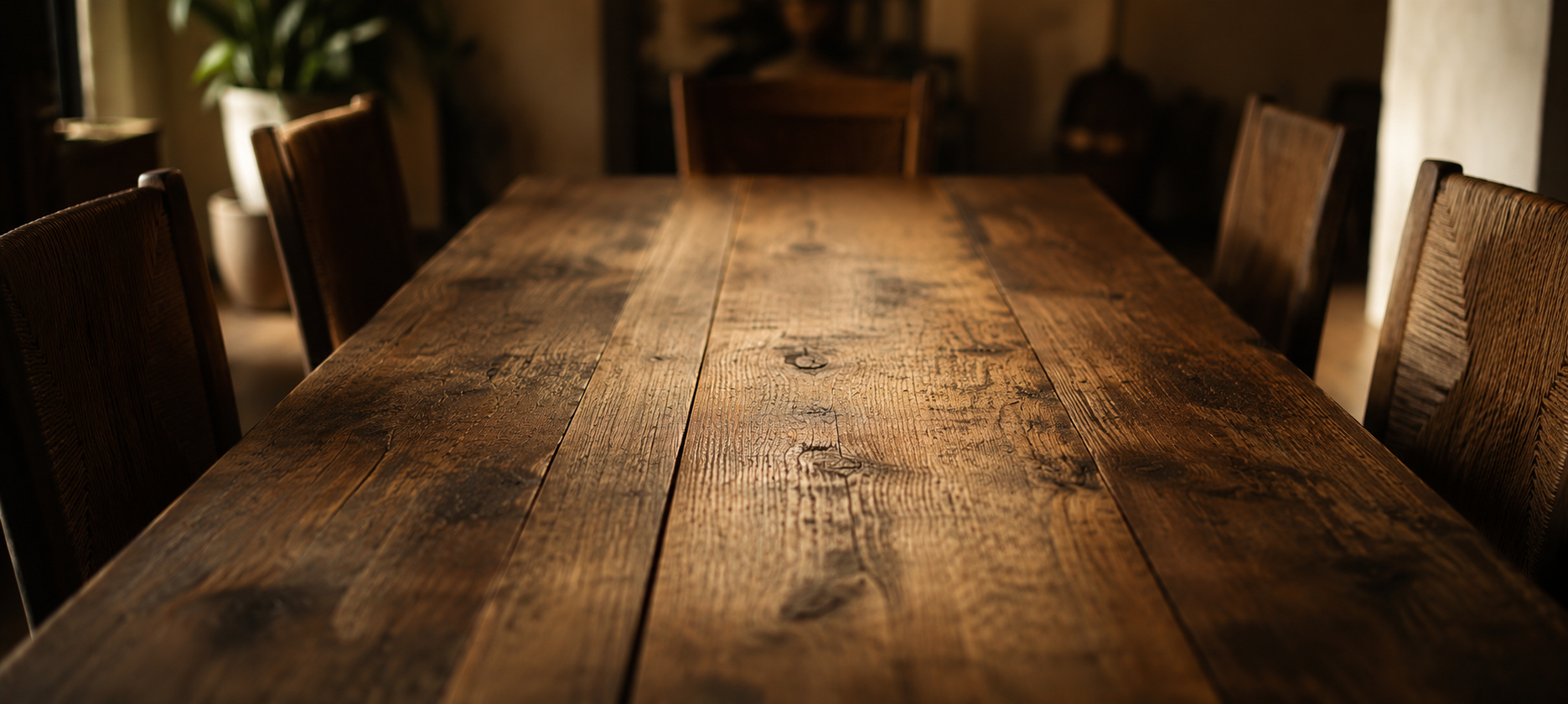
Almost nobody remembers the table.
And yet the table was doing almost all the work. It gave the gathering a shape. It determined who could see whom. It made passing possible. It held the plates, the elbows, the pauses, the small leaning-in after someone lowered their voice. Without it, the meal would not simply have looked different. It would have become something else.
The centre does not always look like importance. Sometimes it looks like furniture. A routine. A person who keeps showing up. A sentence a family repeats until nobody remembers who first said it. A rule never written down. A habit so old it has become climate.
In a room, it may be the chair no one sits in anymore but everyone still arranges themselves around. In a company, it may be the first decision that taught everyone what would be rewarded. In a friendship, it may be the quality of attention established early: whether truth was safe there, whether silence was allowed, whether need had to dress itself up before entering.
We tend to confuse the centre with the busiest part. This is understandable. The busiest part makes itself easy to measure. It fills the calendar. It generates messages. It produces evidence. But busyness is often only the edge becoming noisy. The centre is the thing by which the noise is organised.
Everything has a centre. Problems begin when we mistake the loudest thing for the most important thing.
You can see this most clearly when the centre goes missing.
A house may still contain the same rooms, but after one person dies, everyone walks through it differently. The objects remain. The kettle, the curtains, the framed photograph slightly crooked in the hallway. But something that gave the house its gravitational pull has gone, and all the familiar things begin to drift.
A team may still have the same roles, the same strategy, the same meetings, but after the person who quietly translated tension into clarity leaves, the structure starts to feel thinner. Nothing obvious has broken. No single process has failed. Yet the room no longer knows how to find its own balance.
A person can experience this inwardly too. You continue working, replying, shopping, planning, paying, smiling at the right moment. From the outside, the life appears intact. But something central has been displaced: a devotion, a value, a sense of what the effort was for. The days still happen. They simply no longer gather around anything you recognise.
It is possible to be extremely busy and no longer be organised by anything true.
This is why the question of the centre is not decorative. It is not a question for quiet weekends, annual reviews, retreats, or the rare week when your inbox behaves itself. It is the question beneath all the others. What is this arranged around? What gives this its proportion? What, if removed, would make the whole thing lose its shape?
For a long time, you may not ask. Most people do not. They inherit a centre before they consciously choose one. Family expectation becomes a centre. Success becomes a centre. Survival becomes a centre. Approval. Money. Faith. Beauty. Proving someone wrong. Becoming the kind of person no one can pity. Being needed. Never needing anyone.
A life can orbit almost anything.
The difficulty is that not every centre can hold.
Centuries ago, the Akan carved three circles into cloth.
Not an animal. Not a tool. Not a scene from daily life. Three concentric circles: a centre, a ring around it, and another ring beyond that. Simple enough to be overlooked. Precise enough to become a grammar.
They called it Adinkrahene — the chief of the Adinkra symbols. But the power of the image does not come from domination. It does not command the others like a ruler at the top of a hierarchy. Its authority is quieter. It comes from proportion. From the relationship between centre and circumference. From the idea that what surrounds a thing depends on how the centre is held.
This is what makes the symbol feel less like an emblem of status and more like a discipline of attention. It asks you to stop looking only at what extends outward and return to what everything extends from.
A centre is not important because everything looks at it. A centre is important because everything is changed by its position.
This is true of leadership, though not in the way leadership is usually sold. The strongest leader in a room is not always the person speaking most forcefully or occupying the obvious seat. Sometimes it is the person whose standards have quietly become everyone else's instincts. The person whose way of noticing taught the room what mattered. The person whose patience altered the pace. The person whose refusal to humiliate made honesty possible.
But Adinkrahene reaches further than leadership. It presses on the private architecture of a life. It asks what you have placed at the centre without admitting it. It asks whether the outer rings of your life — your work, relationships, ambitions, spending, rest, speech, attention — are still in proportion to what you claim matters most.
Because drift rarely announces itself as betrayal. It usually arrives as practicality.
You say yes because it would be rude not to. You accept the pace because everyone else seems to be managing it. You postpone the conversation because this week is impossible. You keep the habit because it has become easier than changing. You make the compromise once, then once again, then regularly enough that the outer ring begins to widen away from the centre.
Nothing dramatic happens. That is the danger. The circles do not shatter. They simply lose proportion.
There are moments when life forces the question directly.
A child asks why you are always tired. A friend says, gently, that you no longer sound like yourself. A project succeeds and leaves you emptier than failure did. Someone you love becomes ill, and suddenly the hierarchy you were living by looks absurd in the harsh light of a hospital corridor.
In these moments, the centre becomes visible because the outer life can no longer hide it. You see what has been organising you. You see what you have been serving. You see, sometimes with grief, that the thing at the centre is not the thing you would have chosen if someone had asked you plainly.
But most of the time no one asks plainly. You have to ask yourself.
Not, what do I care about? That question is too easy to answer beautifully. Everyone has language for their best self. Ask instead: what does my life currently protect first? What gets my clearest attention? What is allowed to interrupt everything else? What do I betray slowly, and what do I defend without thinking?
These questions are less flattering. They are also more accurate. The centre is not what you admire. It is what your life keeps arranging itself around.
To return to the centre is not necessarily to simplify your life. It may make life more complicated at first. You may have to disappoint people who benefited from your drift. You may have to abandon a rhythm that made you look impressive while quietly making you absent. You may have to admit that what you called ambition was sometimes fear with better clothes.
But there is relief in proportion. Not ease, exactly. Relief. The relief of seeing what belongs where. The relief of no longer asking the outer rings to become the centre. The relief of remembering that a life can be full without being scattered.
The centre is not always where the light falls. Sometimes it is where the life quietly gathers.
Tomorrow morning, before the day begins its small campaign for your attention, look for the centre.
Not the loudest thing. Not the newest thing. Not the message with the most exclamation marks. Not the task dressed up as emergency because someone else is uncomfortable with waiting.
Look for the thing everything else keeps orbiting.
It may be a person. It may be a promise. It may be a wound you have mistaken for a compass. It may be a devotion so ordinary that you stopped recognising it as sacred. It may be something you need to move back into the middle before the rest of your life can find its shape again.
The eye will keep travelling to the edges. Let it. The world is full of motion, and some of it will matter.
But return, now and then, to the still point.
You may discover it has been holding more than you knew.
Sit With This
What is currently at the centre of your life?
Not what you say matters most.
What your days actually arrange themselves around.
The still point everything else keeps orbiting.
Leave it in the comments below.
