

At first, everyone knows you are going through something.
They ask carefully. They lower their voices. They send messages with too many soft words in them. They remember dates. They check whether you have eaten. They tell you not to worry about replying. For a while, your difficulty has a visible shape, and because it has a visible shape, people know where to place their kindness.
Then time passes.
Not enough time for the thing to be over. Just enough time for everyone else to become accustomed to it.
The updates become shorter. The concern becomes less urgent. The world, which was briefly rearranged around your pain, begins to put itself back together. People return to their own weather. The same difficulty that once made others stop and turn towards you becomes part of the furniture of your life.
You are still inside it.
But now you are expected to answer emails from inside it. Make breakfast from inside it. Laugh at the right moments from inside it. Remember passwords. Pay invoices. Fold laundry. Sit in traffic. Reply, I'm good, thanks, because the alternative would require too much explanation and, besides, the person asking is only being polite.
The hardest part is rarely the crisis itself. It is the long middle, when the crisis has lasted long enough to stop looking like one.
There is a kind of suffering that announces itself. It has a scene, a beginning, a before and after. It gives other people something to understand. Illness. Loss. Uncertainty. Money trouble. Betrayal. Grief. A season of pressure so obvious that no one has to be convinced it is heavy.
And then there is the quieter kind: the difficulty that becomes ambient. Not gone. Not healed. Not solved. Simply absorbed into the routine until it is no longer treated as news.
This is where endurance loses its glamour.
At the beginning, endurance can almost feel cinematic. You are aware of yourself surviving. You notice the effort it takes to get through an hour. You measure courage in small, visible acts: getting out of bed, making the call, showing up, not falling apart in public. Even exhaustion has a certain drama when it is new.
But long endurance is not cinematic. It is administrative. It is quiet, repetitive, practical. It is the same form filled out again. The same medication. The same conversation. The same anxious calculation before sleep. The same problem waiting at the foot of the bed in the morning, patient as a shoe.
You stop asking, How do I get through this? and begin asking smaller questions. What needs doing today? What can wait? Who must not see how tired I am? What part of me can be postponed without being lost?
No one applauds this part.
How could they? From the outside, it does not look like bravery. It looks like your normal life.
There comes a point when what you are carrying becomes so familiar that people stop seeing the weight and start calling it your posture.
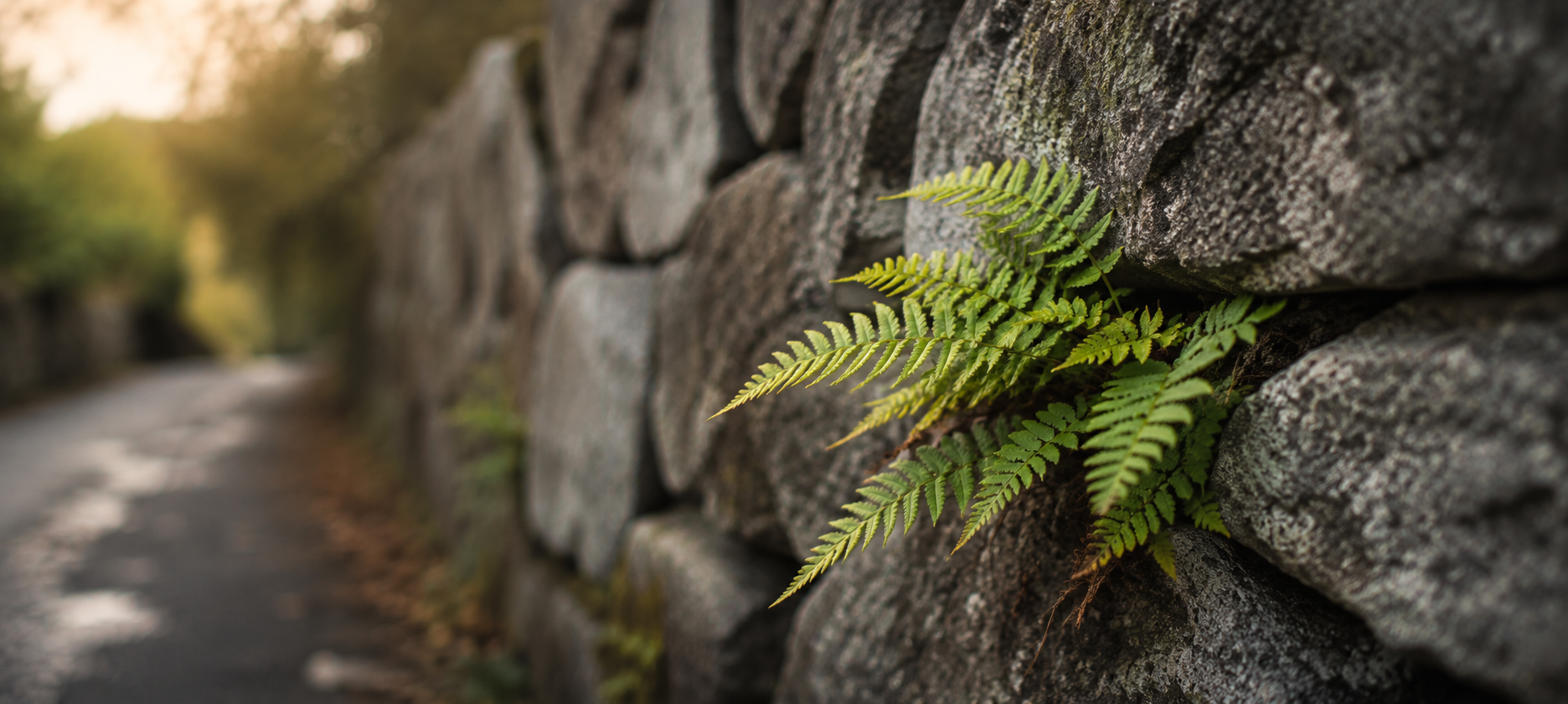
This is the territory the Akan saw when they looked at the fern.
Not the flower at the centre of the garden. Not the tree with its obvious height. The fern. The plant that finds its way into stone walls, old steps, cliff faces, damp corners, thin openings where almost nothing else would think to begin. It does not wait for generous conditions. It does not negotiate with the ground. It studies the crack, accepts the available light, and grows there.
They called it Aya.
It is often spoken of as a symbol of endurance, resilience, resourcefulness, defiance. These words are true, but they can sound too clean. They make endurance appear noble from the beginning, as if the person enduring is always conscious of the beauty of what they are doing.
Aya is more honest than that.
The fern is not inspiring itself. It is not delivering a speech about perseverance. It is not trying to turn hardship into content, or make a lesson out of the wall. It is simply doing what living things do when the ground is ungenerous but life has not finished speaking.
It remains.
And this is where the symbol becomes more unsettling than comforting. Aya does not promise that the stone will soften. It does not promise that a better landscape is waiting just beyond this season. It asks a harder question: what if the life available to you is not the life you would have chosen, and still something in you insists on growing?
Aya is not the romance of overcoming. It is the dignity of continuing before anything has improved enough to be called a victory.
We prefer endurance when it can be shaped into a story.
The difficult childhood that became ambition. The rejection that became discipline. The heartbreak that became self-knowledge. The season of loss that eventually revealed its strange gift. We like the kind of pain that can be explained backwards, once the ending has arrived and made the suffering appear organised.
But while you are still in it, nothing is organised.
There are days when you are not stronger. You are only more familiar with the shape of the difficulty. There are days when your wisdom is indistinguishable from fatigue. Days when you do the brave thing with no brave feeling inside it. Days when you continue not because you have hope, but because stopping would require an energy you no longer have.
This is rarely admitted. We want endurance to sound morally impressive. We want the person who survives to be luminous, clarified, almost grateful. But much of endurance is not luminous. Much of it is awkward and dull. It is becoming efficient at managing what you never wanted. It is learning which drawer contains the documents. Which tone keeps the peace. Which route avoids the memory. Which friend can hear the truth and which friend needs the shorter version.
Slowly, without ceremony, you become competent inside the difficult thing.
This competence can feel like a betrayal. A part of you may resist it. You may think, I do not want to become good at this. I do not want this to be something I know how to live with. There is grief in discovering your own adaptability. It means the life you objected to has been happening long enough to teach you its rules.
Still, something else is also happening.
You are being made specific.
Not better in the easy sense. Not purified. Not upgraded into a more admirable person for the benefit of an audience. Specific. Like a tree shaped by wind, or a shoreline altered by years of contact with the tide. The marks are not decorative. They are evidence of relationship with the world as it actually arrived.
The life that tests you does not always make you stronger. Sometimes it makes you more exact.
There is a private independence that grows in the long middle.
Not the brittle independence of never needing anyone. That is usually fear dressed as strength. This is different. This is the independence of a person who has stopped requiring constant recognition in order to continue. Not because recognition would not be welcome. It would. A kind word can still loosen something in the chest. Being seen still matters.
But it is no longer the fuel.
You learn to move without being witnessed. You learn to honour small private thresholds. The appointment attended. The apology not chased. The bill paid. The morning survived. The conversation left before it became another wound. The quiet decision not to let one more hard day become proof that your life is only hard.
Somewhere in all this, endurance stops being an emergency response and becomes a form of intelligence.
You begin to understand proportion. You know which crisis is real and which one is only noise. You know the difference between urgency and pressure. You know how to make a little beauty without pretending everything is fine. You know how to accept help without turning helplessness into an identity. You know, sometimes painfully, how much can be lost without the whole self disappearing.
This is not the lesson you would have chosen.
But chosen or not, it becomes knowledge.
The fern does not need the wall to become a garden before it begins. It does not postpone itself until the conditions are kind. It does not mistake difficulty for permission to disappear. In the narrow place, it makes a life narrow enough to fit, then wide enough to matter.
Perhaps this is the quiet revelation inside Aya: endurance is not only the capacity to withstand pressure. It is the refusal to let pressure become the only truth about you.
Because even in the long middle, you are not merely waiting for life to resume. You are living. Imperfectly. Reluctantly. With irritation, grace, boredom, fear, tenderness, and all the small negotiations that make a human day possible. You are not on pause until the terrain improves. You are becoming inside the terrain you have.
The ending, when it comes, may not feel like an ending. It may arrive without music. One day you may notice that the thing which once took the whole room has become a corner. Or that your breath no longer changes at the same name. Or that you have made plans without asking pain for permission first.
You may not feel triumphant.
You may simply feel present.
The fern on the wall is not waiting for better ground to become itself. It is already doing the ancient work. Frond by frond. Here, where it was not expected. Here, where it remains.
Sit With This
What has the long middle taught you that the beginning could not?
Not the lesson you would have chosen.
The knowledge that arrived anyway.
The part of you that learned how to remain.
Leave it in the comments below.
