

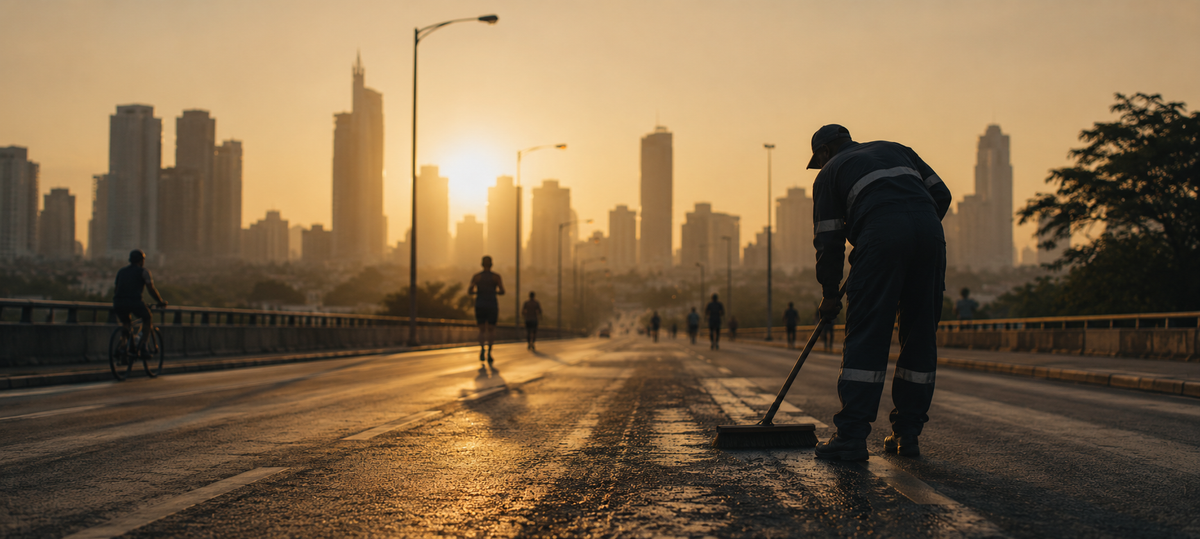
You arrive after the hard part has already happened.
The road is open. The bridge holds. The tap gives water. The lights come on when you turn them on or ask them to. The train arrives close enough to its promise time that you can build a morning around it.
You step into a hospital and someone has already imagined where pain should go. You enter a school and find desks, books, timetables, rules, a language for learning. You walk beneath trees older than your own memory, planted by people who knew they would never sit in their full shade.
Most of what steadies your life was prepared before you arrived.
This is easy to forget because modern life is very good at hiding its foundations.
We notice the things that fail. The delayed flight. The broken lift. The missing parcel. The payment system that collapses at the worst possible moment. Failure makes infrastructure visible. When something works, it disappears into the background and begins to feel like nature.
But almost nothing human is natural in that way.
Someone drew the map. Someone laid the wire. Someone wrote the policy. Someone stayed late to make sure the medicine was stocked. Someone argued for the crossing to be built before another child had to run between moving cars. Someone wrote down the procedure so the next person would not have to panic from nothing.
We inherit systems. We inherit warnings. We inherit language. We inherit recipes, roads, songs, surnames, debts, laws, gestures, habits, griefs and forms of courage. Even our private lives are crowded with people who went first.
None of us begins on untouched ground.
There is a particular kind of mercy in arriving second.
The eldest child knows this differently from the youngest. The first migrant in a family knows it differently from the cousin who arrives years later with an address already waiting. The first person in a workplace to challenge a cruelty knows it differently from the colleague who later benefits from the new policy and never learns how expensive the change was.
Someone absorbs the first shock.
Someone enters the room before the room knows how to receive them.
Someone makes the mistake, takes the insult, learns the form, finds the route, asks the dangerous question, survives the silence after speaking.
And then, because they did, the next person walks through slightly less resistance.
Not always easily. Not without their own struggle. But not through entirely wild ground either.
A path is one of the quietest forms of care.
This is not how we usually speak about achievement.
We prefer the language of self-making. The lone founder. The visionary. The person who came from nowhere and made something of themselves through force of will. It is a seductive story because it flatters both the successful and the audience. It makes greatness look clean. It removes dependency from the picture.
But every life, examined honestly, is less solitary than its public version.
Behind the person who succeeds is often someone who made failure survivable. Someone who kept the house quiet. Someone who lent money without turning it into power. Someone who taught the pronunciation, checked the spelling, opened the door, gave the warning, stayed awake, forgave the arrogance of youth, or carried a burden so another person could appear unburdened.
We are not only made by what we overcome.
We are made by what others prevented from reaching us.
Protection is often invisible because it works before the harm arrives.
The Akan have a symbol called Esono Anantam.
It means the elephant's footprint.
Not the elephant. The footprint.
That choice matters. The symbol does not ask us to admire the animal's size, its strength, its authority in the forest. It turns our attention instead to what the elephant leaves behind after it has passed: the pressed earth, the opened undergrowth, the track through the bush that others can follow.
The Akan aphorism behind the symbol says, Wodi esono akyi a, hasuo nka wo: when you follow the elephant, the dew on the bushes does not touch you.
The image is precise. The dew is not disaster. It is not a storm or a flood or an enemy waiting in the trees. It is the small, ordinary wetness that gathers overnight and clings to the leaves. It is the discomfort that seems minor at first but becomes exhausting over a long journey. The damp sleeve. The soaked hem. The coldness that seeps in gradually.
The elephant has already moved through. The branches have bent. The dew has fallen before you arrive.
Leadership is not the size of the elephant. It is the shape of the path.
This is a demanding idea of leadership because it measures power by its effect on those who follow.
Not by charisma. Not by spectacle. Not by the volume of the leader's voice or the beauty of their stated vision. The footprint asks a simpler question: did your passing make the journey easier for someone else?
That question is inconvenient in an age obsessed with visibility.
We have turned leadership into a style that can be photographed. A posture. A stage. A vocabulary. A personal brand with good lighting. We have learned to recognise the appearance of significance before we have learned to test the ground it leaves behind.
But the footprint is stubbornly practical.
It does not care how impressive the elephant looked while moving. It remains only if something was actually pressed into the earth.
The test of power is what becomes possible for people who do not possess it.
Some of the most important footprints in a life are not left by public leaders at all.
They are left by parents who create a calmer childhood than the one they survived. By teachers who make a student believe intelligence can belong to them too. By friends who enter therapy first and give everyone around them a new language for pain. By neighbours who keep an eye on children who are not theirs. By older siblings who learn the family's rules, then quietly change them.
They are left by the person who says, "That happened to me too," and suddenly shame has a door out. By the colleague who documents everything so the next person is not trapped in confusion. By the grandmother whose thrift becomes someone's education. By the cleaner whose work lets a room feel ready for human dignity before anyone important enters it.
These people are not always called leaders.
Often they are simply called reliable. Difficult. Early. Particular. Too careful. The one who always thinks ahead.
Only later do we realise we were walking in the shelter of their attention.
Most of what holds your life together was built by people you will never fully thank.
The dew in the Akan saying deserves its own attention.
Because much of what wears people down is not spectacular enough to be named as hardship.
It is the form that is impossible to understand. The appointment that requires three phone calls. The workplace where nobody explains the unwritten rules. The family where every generation begins again from the same wound because no one was able to stop and examine it. The neighbourhood without shade. The institution with no memory. The home where a child must grow up before anyone notices they are still a child.
None of these is one great catastrophe.
They are dew.
Small contacts with difficulty, repeated until the whole person is soaked.
Good leadership notices this kind of suffering. It does not wait for people to collapse before calling the path difficult. It clears what it can. It anticipates friction. It asks which burdens have become so normal that people no longer think to complain about them.
The kindest leaders reduce the hardships people have stopped believing can be reduced.
There is also a warning inside Esono Anantam.
Not every large thing clears a path. Some large things crush. Some draw attention to themselves while leaving the forest no easier to cross. Some people want the admiration given to elephants without accepting the responsibility of footprints.
This is where the symbol becomes morally sharp.
It asks us to look past scale and examine consequence. A person may be powerful, followed, wealthy, senior, adored, feared or impossible to ignore. None of that tells us whether they have made a way. The real evidence is found behind them.
Are people less afraid because they were here?
Do others stand taller after being near them?
Did they turn their experience into shelter, or only into status?
A footprint is biography written into the ground.
Perhaps this is the quieter ambition available to all of us.
Not to become enormous. Not to dominate the forest. Not to be remembered in every story told about the journey.
But to leave some part of the path more passable than we found it.
To answer the email that would have frightened our younger self. To explain the process nobody explained to us. To apologise in a family where apology once seemed impossible. To build a home where rest does not have to be earned by exhaustion. To make one room, one workplace, one friendship, one child's future less wet with the dew we once had to push through.
The future is usually built like this.
Not only by grand gestures, but by repeated acts of clearing.
A form simplified.
A story told honestly.
A boundary placed where harm used to enter freely.
A mistake turned into guidance instead of shame.
The future is often protected by people who never expect to see it.
One day, all of us become part of the ground someone else inherits.
Our choices harden into atmosphere. Our silences become weather. Our courage becomes permission. Our avoidance becomes someone else's obstacle. The things we repair may become so ordinary that no one remembers they were once broken.
That may be the strange beauty of a good footprint.
It does not need to be praised in order to serve.
The elephant has already passed. The forest has partly closed behind it. But the earth remembers pressure. The path remains. Someone comes later, perhaps tired, perhaps young, perhaps afraid, and finds that the way is not as harsh as it might have been.
They may never know who went first.
Still, they arrive drier.
The question is not whether people remember your name. The question is whether the ground became easier to cross because you were here.
Sit With This
Whose footprint are you still walking in without realising it?
Most of the lives that shape us do so quietly.
Long before we learn their names, we inherit the roads they cleared, the burdens they carried and the futures they imagined for people they would never meet.
Perhaps the truest measure of a life is not how visible it becomes, but how much easier it makes someone else's.
