

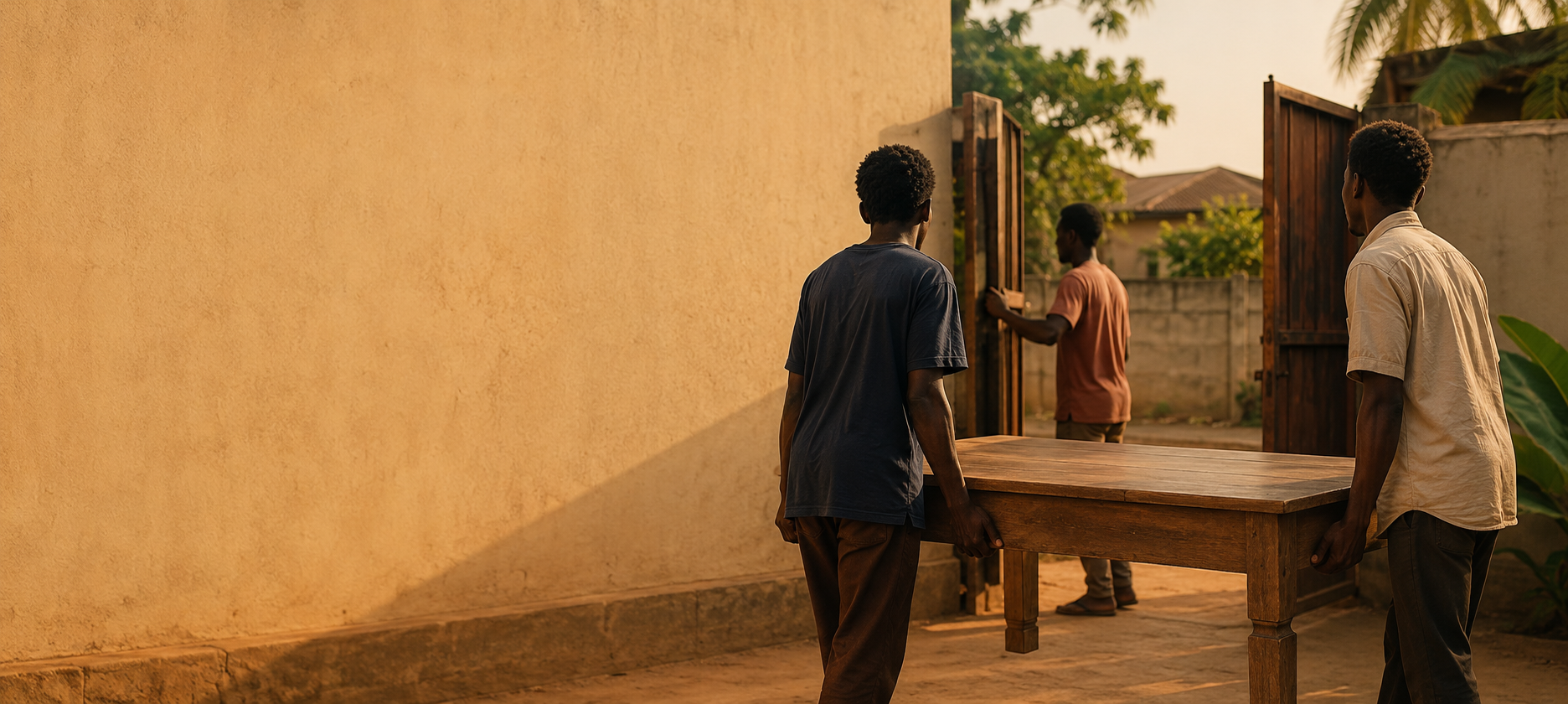
There are things you are carrying today.
A bag. A child. A deadline. A worry that has learned how to sit quietly behind your face. A family expectation. A private grief. A version of yourself other people still need you to be.
Some weight is visible. Most of it is not.
This is one of the first truths a community has to learn if it wants to survive: people are rarely carrying only what their hands reveal. The woman with the shopping may also be carrying a diagnosis. The man answering emails may also be carrying his father’s silence. The friend who says, “No, I’m fine,” may be carrying the cost of having been too much for someone once.
No life has ever been carried by one pair of hands.
Before you carried anything, you were carried.
Someone held your head before your neck could. Someone translated your crying before you had language. Someone taught your mouth the shape of words, then corrected them gently enough that the world became speakable. Someone lifted you over water. Someone opened a door. Someone waited while you tied a shoe badly and then tried again.
A human being begins as an impossible amount of need. This is not a flaw in the design. It is the design. No one arrives self-sufficient. No one learns to stand without first having been steadied by hands already standing.
And still, somewhere along the way, many of us become embarrassed by needing anything. We start treating dependence as a childhood condition we were supposed to outgrow, instead of a lifelong truth that simply changes form. We would rather be exhausted than ask. We would rather be praised for carrying too much than seen accurately as someone who needs help.
The opposite of dependence is not strength. It is isolation.
The Akan gave this wisdom a sentence: Boa me na me mmoa wo. Help me and let me help you.
The phrase is often understood as mutual aid, and that is true, but the English can move too quickly if we let it. Help me. Let me help you. Two movements. Two permissions. Two acts of humility. One person must allow their need to be known. The other must allow their capacity to become available. Neither is passive. Neither is simple.
The symbol does not say, “I will help you because I am generous.” It does not say, “Help me now and I will repay you later.” It says something more intimate and more difficult: let the weight move between us. Let need and strength change places. Let there be a road in both directions.
This matters because many people are willing to help but unwilling to be helped. They know how to arrive with food, advice, labour, money, silence, presence. They know how to read a room and find the person who is struggling. They know how to become useful before anyone asks.
But when the road turns toward them, they close the gate.
There is a particular pride in being the one who carries. It does not always announce itself as pride. Sometimes it sounds like responsibility. Sometimes it sounds like care. Sometimes it sounds like, “This is just who I am.”
But even care can become a way of staying untouchable.
To carry someone else can feel safer than being carried because the person who carries remains in control. They decide the pace. They decide the distance. They can imagine themselves necessary, useful, morally intact. They do not have to experience the strange exposure of receiving. They do not have to stand empty-handed while another person makes an offering.
Receiving is harder than people admit. It asks you to accept that someone has seen a limit you could not disguise. It asks you to trust that the help will not become a debt, a story, a weapon, a reminder of your weakness. It asks you to believe that love can arrive without immediately becoming an account to settle.
Boa Me Na Me Mmoa Wo is not sentimental. It knows that mutual aid requires a moral structure strong enough to hold dignity on both sides. The person who receives must not be reduced to their need. The person who gives must not be enlarged into a saviour. The weight moves, but no one becomes less human because of where it rests for a while.
The strongest communities are not those without burdens. They are the ones that know how to move the burden.
You can see this in the ordinary places if you look carefully.
A neighbour carries a chair across a courtyard without being asked. A cousin takes the children outside so the grieving adults can speak freely. Someone adds an extra portion to a pot because they know who might pass through hungry. A friend sits in silence because advice would be too heavy to add. A colleague quietly covers a task and does not mention it in the meeting. A daughter learns which medicines must be taken with food. A son pretends not to notice that his mother has begun walking more slowly, then adjusts his pace anyway.
None of this looks grand enough to be called philosophy. That is how you know it is real.
Much of community happens at the scale of noticing. Not speeches. Not declarations. Not the dramatic rescue. Just the small shift of weight from one shoulder to another before the person beneath it breaks. This is the intelligence of people who understand that need does not always have language in time.
So a community pays attention before the asking becomes necessary. It learns the normal sound of a person so it can hear when something changes. It learns what absence means. It learns the difference between privacy and disappearance. It learns how to help without turning help into spectacle.
This is not the same as intrusion. Help that does not honour the other person’s dignity is only control with softer language. The wisdom is in the balance: close enough to notice, humble enough to ask, careful enough not to make your help another burden.
There are seasons when you are the one carrying.
You can feel the weight of another person’s life placed partly into your hands. Not all of it. Never all of it. But enough that your choices matter. Enough that your presence changes the temperature of their day. Enough that failing to show up would not be neutral.
In those seasons, the temptation is to imagine that carrying proves something about you. Your goodness. Your reliability. Your strength. Sometimes it does. But the symbol asks a quieter question: can you carry without making the burden about your own character? Can you help without needing the help to testify on your behalf?
There are also seasons when you are the one being carried.
This may be harder. You may feel useless. You may feel embarrassed by how little you can offer back. You may begin making promises about repayment, as if gratitude must immediately become labour. But there are moments when the most generous thing you can do for a community is allow it to be what it says it is. Let the hands hold. Let the meal arrive. Let the friend sit with you. Let someone else be strong without treating your need as a moral failure.
Sometimes the work is not to give more. Sometimes the work is to stop refusing the gift.
The phrase says, help me and let me help you, because a community is not a warehouse of favours. It is a living system of exchanged weight. The child becomes the adult. The strong become tired. The well become ill. The grieving become comforters. The person who once needed rent becomes the one who pays someone else’s school fees. Time rearranges the positions. No one remains only the helper. No one remains only the helped.
This is the mercy of it. The burden moves.
When need becomes shame, people hide until the damage is larger than it had to be. When help becomes performance, people stop trusting the hand that reaches for them. When self-sufficiency becomes the highest virtue, everyone becomes lonelier and calls it discipline.
The Akan proverb refuses that loneliness. It insists that personhood is relational, not because the individual does not matter, but because the individual has never been made alone. You are here because someone carried something for you: a name, a language, a sacrifice, a silence, a hope, a bowl of food, a door held open at the right time. Some of those people are known to you. Many are not. Your life is full of anonymous hands.
And now your own hands are part of someone else’s evidence that the world can still hold.
Tomorrow you will carry something again. A bag. A task. A conversation. Someone’s disappointment. Your own unfinished becoming. Before the day ends, another person will probably carry something for you, even if you do not notice it at the time.
Notice it.
Not to feel indebted. To become accurate.
None of the things that made you possible were carried by you alone.
Every human life is a relay of invisible hands.
Sit With This
What are you carrying alone that was never meant to be carried alone?
The weight you receive.
The weight you carry.
The weight you keep refusing to let move.
Who has helped carry you here — and who are you allowing to help carry you now? Leave it in the comments below.
