

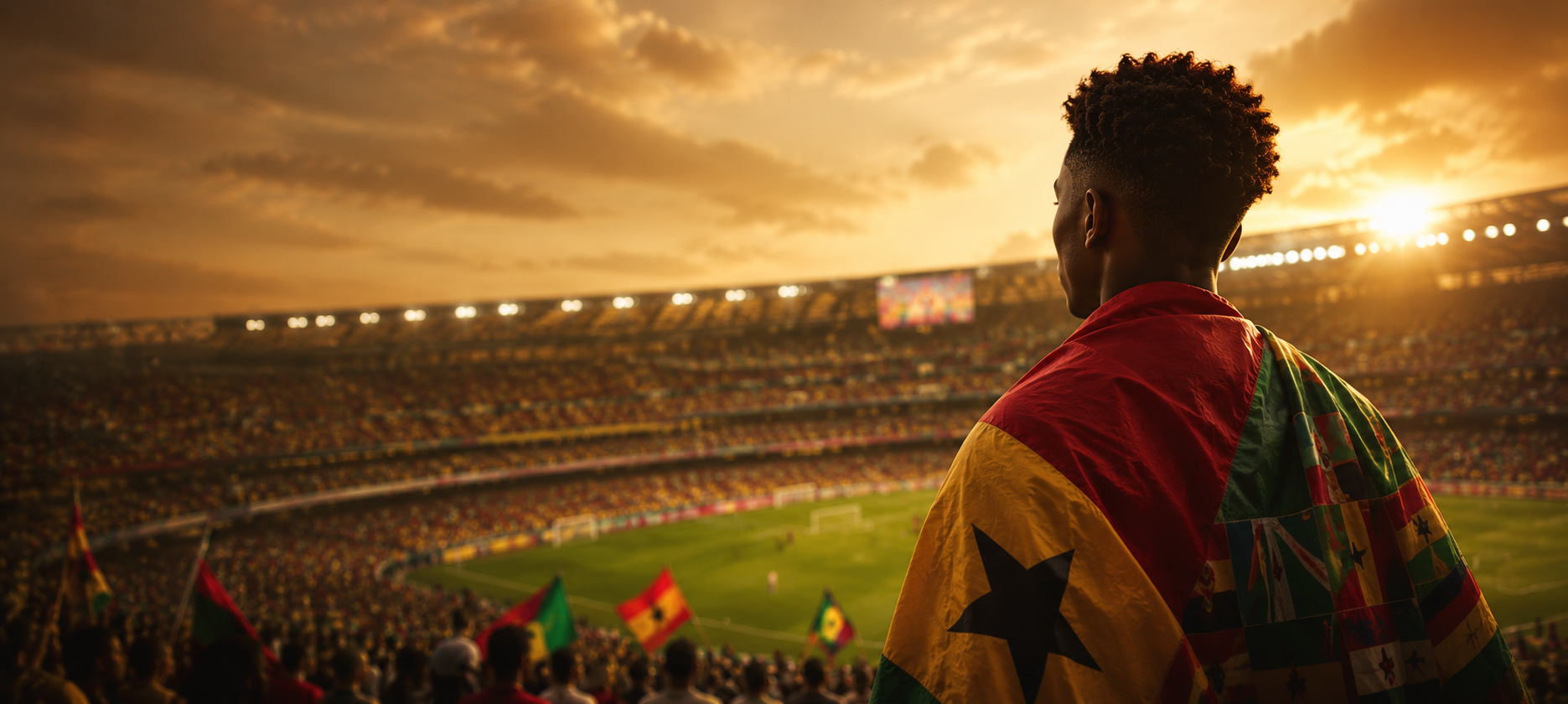
There is a temptation, every four years, to believe that the World Cup is about football.
The evidence seems overwhelming. Ninety minutes. Eleven players. Goals, tactics, substitutions, formations, expected goals, high presses, low blocks, VAR decisions that consume entire evenings and divide entire countries. Television cameras linger on the ball because the ball appears to be the thing everyone has come to see.
But the ball has always been the excuse.
The World Cup has never simply revealed who plays football best. It reveals something much stranger than that. It reveals how the world understands itself.
This year, that story is impossible to ignore.
Not because someone scored from forty yards.
Not because another favourite crashed out.
Not because VAR worked — or failed.
Because identity has become the tournament’s dominant storyline.
Football has become the world’s largest public conversation about belonging.
You could almost miss it if you watched only the highlights.
You have to watch the line-ups instead.
The surnames.
The anthems.
The embraces after the whistle.
The conversations between parents in the stands.
The tears that arrive when a flag rises above a player who, a generation earlier, would almost certainly have been wearing another one.
Football has become the world’s largest public conversation about belonging.
And it is happening in front of billions of people.
The shirt used to answer the question
The language of international football is supposed to be simple.
A nation chooses its players.
Those players represent that nation.
The shirt answers the question before anyone asks it.
Who are you?
But the world stopped being that simple a long time ago.
Migration redraws maps more quietly than wars do.
Families move.
Children grow up speaking one language at school and another at home.
A passport arrives years before a sense of home does.
Sometimes the opposite.
By the time a young footballer reaches the highest level, nationality has become only one fact among many.
Birthplace. Citizenship. Parents. Grandparents. Memory. Language. Faith. Food. Music. Expectation. Gratitude. Loss.
All of these become part of the decision.
International football asks a question that governments, borders and passports have never fully answered: where do you belong?
Two brothers, two shirts
Consider two brothers.
Nico Williams wears Spain.
Iñaki Williams wears Ghana.
The same parents.
The same childhood.
The same table.
The same stories.
One family.
Two national teams.
If football were merely about nationality, this would feel contradictory.
Instead, it feels completely understandable.
No one watches them and asks which brother is the real son.
Because that is the wrong question.
Each has answered a different version of belonging.
Neither answer cancels the other.
Their story has become one of the defining images of this tournament — not because brothers choosing different countries is unprecedented, but because it feels increasingly familiar.
It reflects the lives of millions of people who have inherited more than one home.
Every squad list becomes a family tree
The same pattern appears everywhere you look.
A player born in one country represents another.
Another chooses the nation of a parent.
Another returns to the country his grandparents never left emotionally, even after geography separated them.
Every squad list becomes a family tree.
Every knockout fixture becomes a conversation about migration.
Suddenly the bracket looks different.
Not Europe against Africa.
Not South America against Europe.
Not Asia against North America.
Something more complicated.
Something more honest.
Morocco against the Netherlands.
Belgium against Senegal.
England against DR Congo.
On paper they are opponents.
Underneath the paper, many are participants in the same story.
The lines separating them begin to blur.
The Akan already had a word for this
The Akan recognised this long before football existed.
They carved a symbol called Funtunfunefu Denkyemfunefu.
Two crocodiles.
Two heads.
One stomach.
It is often described as a lesson about unity.
That is true.
But it is incomplete.
The brilliance of the symbol is not that the crocodiles are identical.
They are not.
They look in different directions.
They compete.
They disagree.
They possess separate minds.
The tension is not erased.
It is acknowledged.
The revelation comes afterward.
Despite everything that separates them, nourishment arrives in the same place.
Whatever one head consumes ultimately feeds the other.
Competition exists.
Interdependence survives it.
That is the difficult part.
The crocodiles cannot become strangers merely because they behave like rivals.
Global history wearing football boots
The World Cup has become an enormous theatre for this paradox.
Players compete with extraordinary intensity.
Nations celebrate victories.
Supporters suffer defeats.
This matters.
Competition matters.
Identity matters.
Flags matter.
But beneath the spectacle runs another current.
The tournament increasingly reveals how intertwined our histories have become.
The son of Ghana scores for England.
A player with Congolese roots lines up for Belgium.
France’s squad tells the story of the twentieth century as much as it tells the story of French football.
Spain cannot be understood without migration.
Neither can Morocco.
Neither can England.
Neither can almost anyone.
What we are watching is not simply international football. It is global history wearing football boots.
The embrace after the whistle
Perhaps this explains why certain celebrations now feel different.
When players exchange shirts after ninety fierce minutes, it no longer feels like courtesy.
It feels like recognition.
An acknowledgement that today’s opponent might easily have been tomorrow’s teammate.
Or yesterday’s neighbour.
Or a cousin.
Or someone whose parents once stood in the same immigration queue.
The shirts change.
The stories overlap.
Football has become one of the few places where these overlapping identities are visible enough for billions of people to witness simultaneously.
Not hidden.
Not abstract.
Not theoretical.
Visible.
Who gets to claim you?
This is why the tournament feels emotionally larger than it once did.
The stakes are no longer confined to silverware.
When Morocco advances, children across several continents recognise themselves.
When Ghana plays, conversations unfold in London, Amsterdam, Toronto and New York alongside Accra and Kumasi.
When a player chooses one country over another, newspapers describe it as a sporting decision.
Families recognise it as something much deeper.
It is a decision about memory.
About gratitude.
About inheritance.
About who gets to claim you.
Perhaps that is why the World Cup still matters in an age when club football dominates almost everything else.
Club football asks who you play for.
International football asks who you are.
The answers no longer fit neatly inside borders.
And maybe they never truly did.
Remember the shared stomach
Funtunfunefu is not asking nations to stop competing.
Without competition, there is no tournament.
It is asking something more demanding.
Remember the shared stomach.
Remember that rivalry does not erase relationship.
Remember that history survives the scoreboard.
The symbol refuses the comforting fantasy that division creates complete separation.
It never has.
Not in families.
Not in nations.
Not in football.
Two heads. One stomach. The World Cup did not invent this story. It simply gave it the largest audience on Earth.
Perhaps the defining image of the 2026 World Cup will not be the winning goal.
Perhaps it will be something quieter.
Two brothers in different shirts.
An embrace after ninety minutes.
A flag chosen without rejecting another.
A player singing one anthem while carrying another history.
The tournament keeps insisting that identity is no longer a single inheritance.
It is layered.
Negotiated.
Remembered.
Chosen.
Shared.
And centuries before football became the world’s game, the Akan carved a reminder into wood and cloth.
Two heads.
One stomach.
The World Cup did not invent this story.
It simply gave it the largest audience on Earth.
The final whistle always ends the match. It has never been able to end the story.
Sit With This
Where in your life have you mistaken difference for separation?
In your own body.
Or in the family that shaped you.
The country you left, the country that raised you, the flag you carry, the history that carries you — all of it is worth sitting with.

Reflections shared