

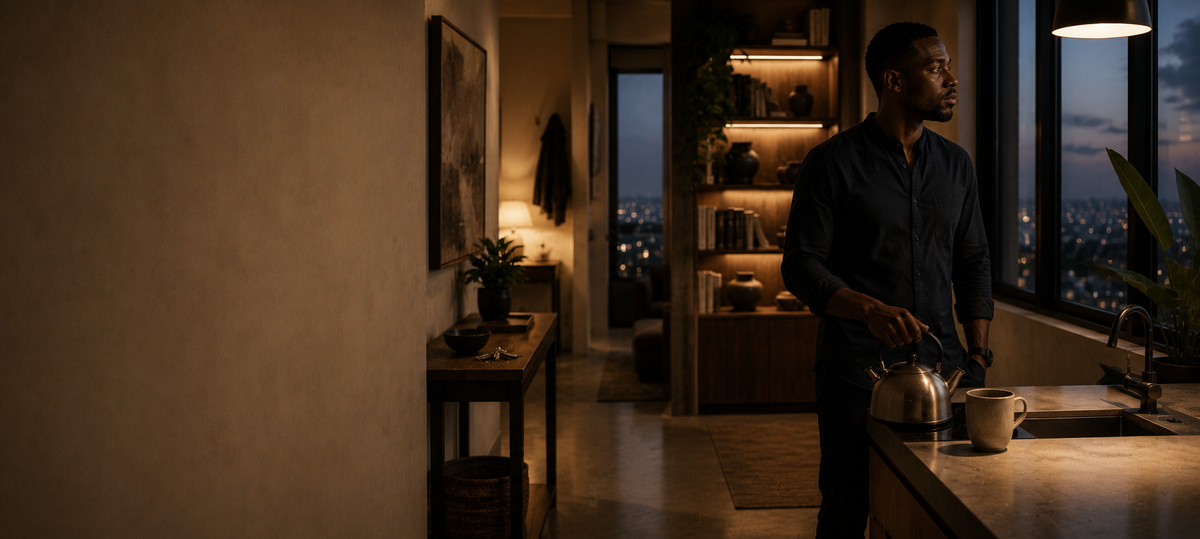
You unlock the front door.
Your keys find the bowl by the hallway without looking. Your shoes come off in the same place they always do. The kettle goes on. A cupboard opens. A favourite mug appears in your hand before you remember choosing it.
The whole sequence takes less than a minute.
Then, while you wait for the water to boil, a peculiar thought arrives.
When was the last time I actually decided to live like this?
The life that feels most natural is not always the life we chose.
Most of us spend more time on autopilot than we realise. That is not a flaw. Habit is one of the quiet kindnesses of being human. It remembers what the mind no longer needs to carry. It lets us drive familiar roads, tie shoelaces, greet neighbours and prepare breakfast without exhausting ourselves with endless decisions.
Life would become impossible without it.
The difficulty is that habits remember equally well what still belongs to us and what quietly stopped belonging years ago.
A conversation we always avoid. An apology we never quite make. A version of ourselves that learned long ago how to keep the room comfortable. The ambition inherited from someone else's expectations. The schedule that once solved a problem but slowly became our identity.
Habits rarely ask whether they are still true. They simply ask to be repeated.
This is why the most unsettling moments often arrive inside the most ordinary ones. Standing in a supermarket wondering why we keep buying food we no longer enjoy. Walking the same route to work and suddenly noticing a street we have passed for years without seeing. Laughing at a joke we no longer find funny because we have always laughed there.
Recognition rarely announces itself dramatically. More often it interrupts routine.
There is an odd grief in discovering how easily a life can continue without fresh consent. Nothing is necessarily wrong. The bills are paid. Relationships endure. Work gets done. From the outside, everything appears stable. Yet somewhere beneath competence a quieter question begins asking whether stability and aliveness are always the same thing.
Centuries ago the Akan built a philosophy around that question.
They called it Asetena Pa.
It is often translated as good living. But the phrase reaches beyond comfort or success. It points toward a life that remains consciously inhabited—a life that continues to be chosen instead of merely continued.
Good living is not perfect living. It is refusing to sleepwalk through the life that is yours.
That difference changes the question entirely.
Instead of asking whether your life looks successful, Asetena Pa quietly asks whether it still feels recognisable from the inside.
The Akan understanding of character, suban, was never something inspected once and filed away. Character required returning. Looking again. Not because people constantly changed beyond recognition, but because life did. Every season quietly renegotiated who we were becoming.
Think about the roles we collect. Child. Student. Partner. Parent. Manager. Friend. Carer. Founder. Mentor. Each asks something real of us. Each leaves behind habits that once served us well. The danger comes when roles survive the season that created them.
Someone who learned never to disappoint anyone at twelve may still be living by that rule at forty-five. A person who spent years surviving financial uncertainty may continue behaving as though every act of generosity threatens catastrophe long after stability has arrived. We often inherit ourselves from older versions that were simply trying to cope.
Nothing about this deserves judgement.
It deserves attention.
The examined life is not a trial. It is a conversation.
That conversation often begins with remarkably small questions. Why do I always apologise first? Why does silence make me uncomfortable? When did weekends become recovery instead of delight? Why do I keep saying I am too busy for the very things I once said mattered most?
Answers arrive slowly. Sometimes months apart. Sometimes while hanging washing, waiting in traffic or watching rain gather on a window. Clarity has an inconvenient habit of visiting ordinary places.
Perhaps this is why genuine self-examination rarely feels dramatic. It looks like someone quietly pausing before saying yes. It looks like declining an invitation without inventing an excuse. It looks like admitting that a dream has changed instead of pretending the old one still fits.
None of these moments would appear significant to an observer.
Together they reshape a life.
There is another question hidden beneath all of this.
By whose measure are you living?
Modern life supplies an endless collection of rulers. Productivity. Visibility. Income. Influence. Followers. Promotions. Square metres. Even wellness can become another performance measured against someone else's photograph.
The problem is not that these measures are meaningless. Many describe something genuinely valuable.
The problem begins when they become the only language through which we recognise a life.
The Akan understood personhood differently. A life was not finally measured against another person's accomplishments but against its own spirit—its own capacity to become fully itself. Failure was not merely falling behind others. It was remaining estranged from your own nature.
That is a subtler disappointment.
It explains why people sometimes achieve exactly what they once wanted and still feel strangely absent inside it. Success can answer the wrong question beautifully.
There are moments when the world applauds while something quieter within us remains unconvinced.
Asetena Pa invites us to trust that quieter voice—not because it is always comfortable, but because it usually recognises the difference between admiration and belonging.
Belonging is difficult to fake.
You feel it when your life fits from the inside.
You also feel its absence long before you can explain it.
None of this suggests abandoning responsibilities or beginning again every time dissatisfaction appears. The examined life is not restless. It is attentive.
Sometimes examination confirms that the ordinary life you already have is exactly the one you wish to continue choosing.
Sometimes it reveals that only a single conversation, a boundary, a forgotten delight or an honest admission needs changing.
Sometimes the greatest transformation is simply discovering that you have been present all along.
That is why Asetena Pa is not a destination. It is a practice of returning. Returning to the life beneath the routines. Returning to the questions beneath the answers. Returning often enough that habit never quietly replaces intention.
Every now and then you will still walk through your front door, place your keys in the bowl, boil the kettle and pause halfway through making tea.
The difference is that the pause will no longer feel accidental.
It will be part of the life you have chosen.
Asetena Pa reminds us that good living is not measured by how perfectly we organise our days, but by how honestly we continue inhabiting them.
Some lives collapse because they are neglected.
Others slowly disappear because they are never questioned.
The quieter danger is not failure.
It is forgetting that this life is still yours to choose.
Sit With This
Which part of your daily routine feels so automatic that you no longer remember choosing it?
The familiar routine.
The quiet pause.
The life becoming yours again.
What would you choose again today if you were beginning from the inside rather than from habit?
