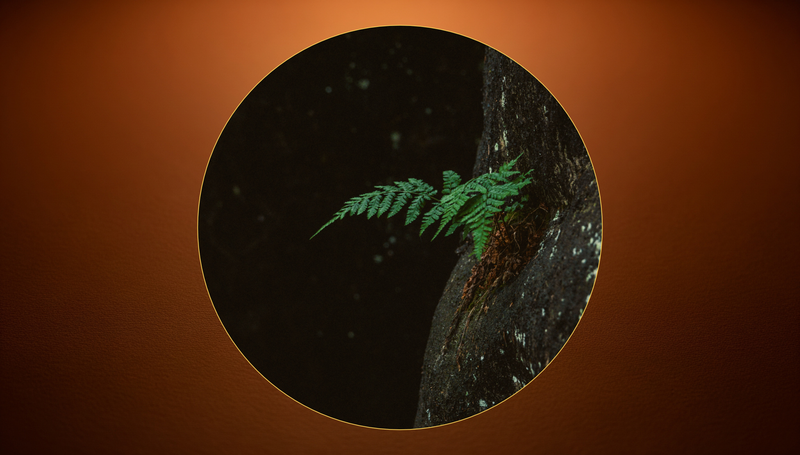
The fern does not grow where conditions are favourable. It grows where other plants have given up — in rock crevices, in deep shade, in the thin soil at the edge of things. The Akan people of Ghana looked at this and called it not luck but philosophy. Aya, the fern, is the symbol of endurance not as passive suffering but as active, rooted, unheroic persistence — the kind that requires no audience and produces no drama, and simply keeps growing regardless.
Results for aya


You are still in it. Not approaching the end — or if you are, you cannot see it yet. The difficulty has been present long enough that you have stopped orienting yourself toward the moment it resolves. Aya — the fern — does not demonstrate endurance. It is endurance. Present tense. Growing in the available ground.


This is not a prayer made from desperation. It is a prayer made from knowledge. The Akan people of Ghana did not look at the sky and see emptiness — they saw something specific held there, in readiness, by a God who was attentive and present. Nyame Biribi Wo Soro: God, there is something in the heavens — let it reach me. The something already exists. Faith is not creating it. Faith is remaining open to its arrival.


The seed of the wawa tree is one of the hardest in the West African forest. That hardness is not incidental — it is produced by the conditions that the seed must survive before it can germinate and grow. The Akan people of Ghana looked at this and drew a conclusion: the difficulty does not prevent the growth. It creates the conditions in which the growth, when it comes, is strong enough to matter. Wawa Aba is the symbol of that process — hardness as preparation, not damage; adversity as the thing that makes you what you needed to become.

The road is twisted. This is the Akan observation — not a complaint, not a warning, but a plain statement offered as the basis for a practical instruction: if the road is twisted, learn to twist with it. Nkyinkyim is the symbol of that learning — the continuous, purposeful, unhurried turning that gets you where you are going by the path the road actually makes available. Adaptability not as the abandonment of purpose, but as its most intelligent expression.

One person cannot divide the sack of cola nuts alone. This is the Akan proverb at the heart of Bese Saka — and it is not a complaint about logistics. It is a complete philosophy of wealth: that prosperity only becomes real in the moment of its distribution, that what you accumulate achieves its full meaning only when it moves from your hands into the hands of those around you. The sack of cola nuts. The open hand. One inseparable thing.


A sword does not swing by itself. The Akan proverb at the heart of Akofena is not about the blade. It is about the arm — and behind the arm, the person — and behind the person, the soul that makes the wielding honourable rather than merely powerful. Two crossed swords: balanced, deliberate, the image of force accountable to the character of the one who holds it. Courage, in Akan philosophy, was never just fearlessness. It was the willingness to act rightly, from the deepest part of who you were.

The crocodile lives in water yet it breathes air. Seven words in Twi that contain a complete philosophy of existence across difference. The Akan people of Ghana looked at the crocodile and saw not a monster but a model: the creature that masters two environments simultaneously, that belongs fully to both, that carries its essential nature with it wherever it goes. Denkyem is the symbol of that mastery — not adaptation as loss of self, but adaptation as its fullest expression.

Asase Ye Duru means the earth has weight. Not only the weight of its mass, but the weight of what it sustains — every life, every lineage, every act of the divine. The Akan proverb makes a remarkable claim: without the earth, even the supreme being cannot act. The ground beneath you is not backdrop. It is foundation.

In Twi, the language of the Akan people of Ghana, to tell someone to get a heart — nya akoma — is to tell them to be patient. To say someone has no heart — onni akoma — is to say they are impatient. The heart, in this tradition, is not the seat of feeling. It is the seat of endurance. Akoma, the heart symbol, carries a meaning deeper than love: the willingness to remain, to hold, to show up again and again for what you have committed to, on the days when it costs something.

Every night without exception, the North Star is there. She does not announce her return. She takes her place as the sky darkens and waits — steadily, without complaint, for the moon to come back. The Akan people of Ghana saw this and called it love. Not the feeling, not the declaration. The faithfulness. Kyekye pe awaree: the North Star loves marriage. She is always there. Osram ne Nsoromma — the moon and the star — is the symbol of the love that has become a nature rather than an effort.

There are things that fire cannot consume. The traditional Akan priests who walked barefoot across hot coals and emerged unburned were not performing a miracle. They were demonstrating a truth about what certain qualities of character and faith produce in a person: something the fire cannot finish. Hye Won Hye — that which does not burn. Not a promise that the fire will not come. A statement about what you have become in relation to it. I have been through this. I am still here. The fire did not win.


Adinkra symbols are one of Africa's most sophisticated visual languages. Here's what they mean, where they came from, and why they still matter today.