

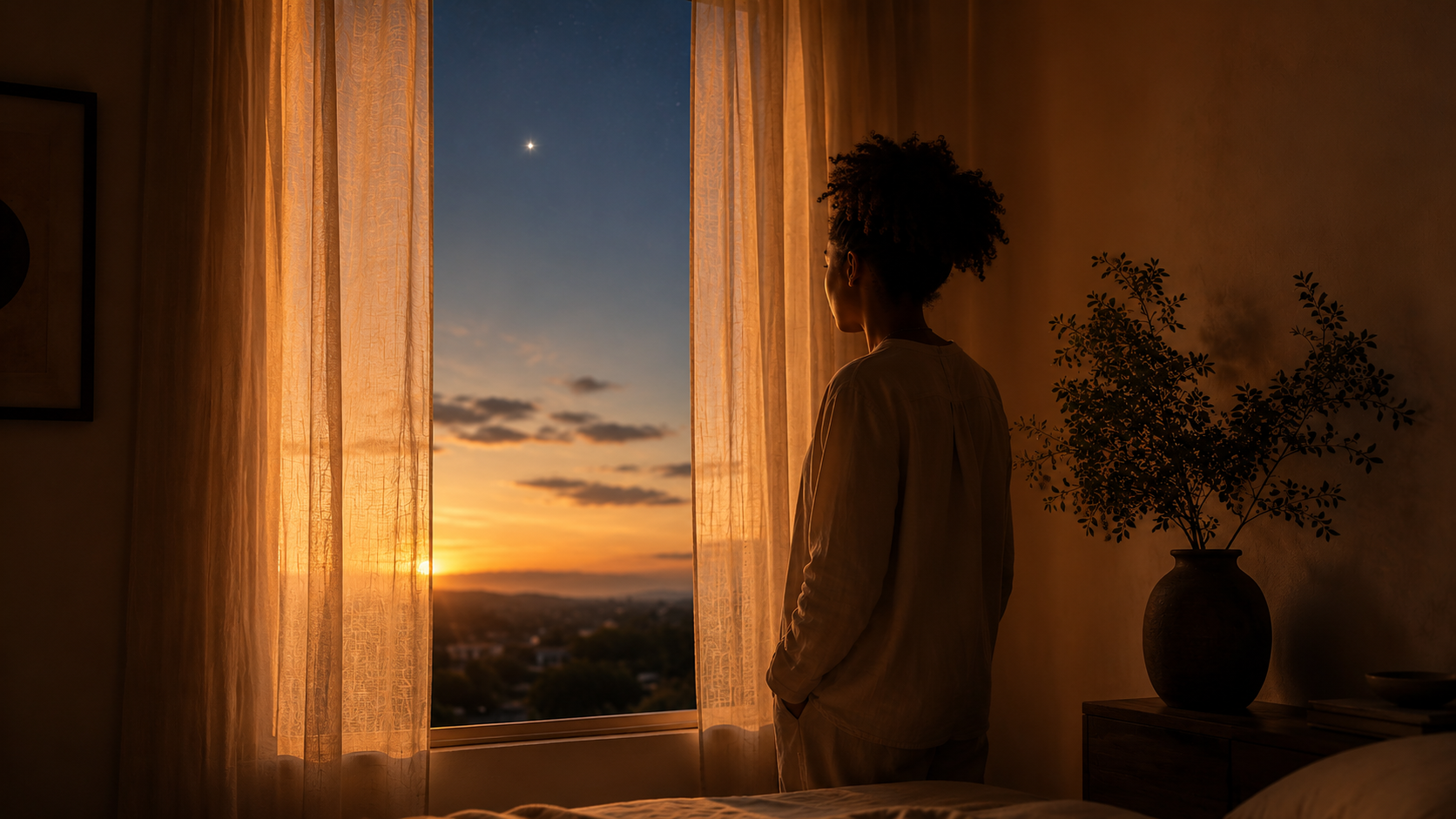
You wake before the alarm.
For a moment you do not know where you are.
Not in the frightened way.
In the gentler way.
The brief moment before the day remembers your name and hands it back to you.
The light through the curtain looks like something almost remembered.
Then the day begins.
The messages.
The calendar.
The quiet inventory running somewhere in the background of your mind.
What needs doing.
What did not get done yesterday.
What is coming toward you that you are not sure you are ready for.
You reach for the phone before your feet reach the floor, as if the world might have shifted in the night and it is your responsibility to find out first.
The inbox opens.
The bank app loads.
The weather appears.
A headline passes by, then another, then a photograph of someone you do not know living a life that appears, for two seconds, more composed than yours.
Most of us begin the day this way.
Already measuring.
Already preparing.
Already negotiating with ourselves.
What if vigilance is not the same as care?
There is a kind of tiredness that does not come from labour.
It comes from supervision.
From the private belief that everything important must be watched or it may disappear. Love must be maintained. Work must be proved. The future must be anticipated before it becomes unreasonable.
We call this adulthood, and some of it is.
Bills do not pay themselves. Children do not walk themselves to school. The body does not remain well because we have decided to ignore it. Responsibility is real, and any philosophy that pretends otherwise is not wisdom but decoration.
But underneath responsibility, something else often grows.
A quieter conviction.
That if you stop holding everything, everything will fall.
You see it in the small rituals of modern life. The person refreshing a tracking link for a package that cannot be made to arrive faster. The woman rereading a message before sending it, softening one sentence, then another, trying not to become too much. The man sitting in a parked car outside his own home because the room inside contains people who need him, and he needs thirty seconds to become useful again.
No drama.
No collapse.
Just the daily theatre of people trying to be the frame around their own lives.
We have confused responsibility with ownership.
That is the exhausting part.
Responsibility says: this matters, so I will attend to it.
Ownership says: this matters, so it depends entirely on me.
The difference can be difficult to feel because both appear virtuous from the outside. Both answer emails. Both remember appointments. Both keep going when they are tired. Both look like maturity. But only one leaves room for breath.
The other slowly turns life into an object you must hold above your head.
And because the object is invisible, nobody knows how heavy it has become.
By late morning you are already performing a version of yourself that can manage.
You reply with exclamation marks you do not feel.
You say, No worries.
You say, I can do that.
You say, Let me check and come back to you.
The day asks for fragments, and you keep handing them over.
Am I enough for this?
Most people spend more time than they realise trying to become worthy of the life they already occupy.
Worthy of rest.
Worthy of tenderness.
Worthy of being helped.
Worthy of taking up space in their own homes, their own work, their own days.
The methods differ.
But the underlying bargain is usually the same.
If I become enough, perhaps I will finally feel allowed to be here.
The trouble is that the bargain never stays fulfilled for long.
There is always another task.
Another version of yourself waiting somewhere beyond the horizon.
Another small proof required by no one in particular and yet urgently demanded by something inside you.
The modern burden is often carried by people who are not visibly alone.
They have contacts, colleagues, families, group chats, maps that tell them when to turn left, calendars that remind them of their own lives. Still, many move through the day with the private sensation that there is no net beneath them.
Support exists everywhere except, often, in the imagination.
Centuries ago, the Akan recognised a different starting point for the human being.
They named it Nsoromma.
Literally, it carries the sense of a child of the heavens, a child of God. But the power of the symbol is not merely theological. It is emotional. It imagines the person not as a sealed, self-made unit moving through a neutral world, but as a life placed within relation. A life received before it could perform. A life attended to before it could explain why it deserved attention.
In the symbol's old intelligence, the star matters not because it invented its own light, or chose its own height, or secured its own position in the dark. It matters because it has been placed. Because it shines from within an order larger than itself. Because its small light is not made less real by the fact that it did not create the sky.
The opposite of dependence is not freedom.
It is exhaustion.
That is the turn Nsoromma makes quietly, almost without argument.
Modern life teaches us to treat dependence as an embarrassment. To need too much is childish. To ask is risky. To admit uncertainty is to lower one's market value. Even rest is often smuggled into the day under the language of optimisation, as if sleep must increase productivity before it can be justified.
There is a particular loneliness in being considered capable. People trust you with things. They assume you will answer. They admire your steadiness. They come to depend on the very self-control that is quietly emptying you out.
Capability can become a beautiful prison.
Nsoromma does not romanticise helplessness. A star still shines. It gives light. It becomes useful to those looking for direction. It participates in the world. The symbol is not asking a person to become passive, or vague, or spiritually decorative.
It is asking something more difficult.
Can you act without believing you are the source of all holding?
Can you care for what has been placed in your hands without imagining that your hands are the only ones involved?
This is where the symbol becomes more than comfort.
It becomes a correction.
Because the person who believes everything depends on them will eventually begin to resent the very things they love. The work. The family. The body. The dream. The home. The people who ask. The people who do not ask but still somehow need. What began as devotion becomes a form of silent accusation: why must I be the one who keeps this alive?
But perhaps some of the bitterness comes not from loving too much, but from believing love has no larger architecture around it.
Perhaps we become hard not because the world asks us to carry things, but because we forget that we are also being carried.
By afternoon, the light has changed.
You notice it on the side of a building.
On the surface of a bus window.
Across the table where a half-finished drink has left a ring.
Someone holds the door without making a performance of kindness. A friend sends a message at the exact moment you were preparing to disappear into yourself. A stranger moves their bag so you can sit down. The cashier smiles, not enough to transform your life, but enough to remind you that you are not moving through a machine.
These are not miracles in the dramatic sense.
They are barely events.
And yet the day is full of small evidence that life is not only something we push forward by force. It also comes toward us. It offers handles. It sends witnesses. It makes room in ways too ordinary to survive as testimony.
This may be why being held is so hard to remember.
It rarely announces itself.
It is the floor not giving way.
The chair bearing weight.
The friend who does not ask you to be impressive.
The breath arriving again after you had forgotten to notice it.
The old song in a shop that returns you, suddenly, to a version of yourself you thought was gone.
Nothing about this cancels difficulty.
Nsoromma is not a promise that the day will be gentle. The Akan were not naive about suffering, and no serious philosophy begins by pretending pain is a misunderstanding. People lose things. Plans fail. Bodies change. Love disappoints. The email lands badly. The bank balance remains what it is. The appointment still has to be made.
But there is a difference between facing difficulty and believing difficulty is proof that you have been abandoned.
There is a difference between being responsible and being alone.
This is the dignity inside the symbol.
Not the kind of dignity that arrives after achievement, when the world finally applauds and the evidence is visible.
A prior dignity.
The dignity of having been placed here before you became useful. Before you became impressive. Before you learned how to read a room, answer quickly, make yourself needed, make yourself acceptable.
You were not first a project.
You were first a life.
That distinction is small enough to miss and large enough to change the atmosphere of a day.
Evening comes with its ordinary negotiations.
What to eat.
What to answer.
What to leave until tomorrow.
The room gathers itself around you. The ceiling is familiar. The sounds beyond the walls are familiar. Someone nearby runs water. A car passes. A notification lights the phone, then fades.
You may still be tired.
You may still have handled the day imperfectly.
You may still owe someone a reply.
But perhaps the question waiting at the edge of sleep is not whether you did enough to justify your place in the world.
Perhaps the question is gentler than that.
Did you notice what carried you?
Tomorrow morning, you may wake before the alarm again.
The room will return slowly.
The light will come through the curtain.
The list will begin its old work.
And before the day hands you your name, before you reach for the phone, before you remember what must be solved, something older than effort may already be there.
Not loud.
Not provable in the way the world prefers.
Only steady.
As if, long before you opened your eyes, your life had already been remembered.
SIT WITH THIS
When did you notice what carried you today?
Not the grand rescue.
Not the obvious kindness.
The small support you almost missed.
Sometimes the day does not become lighter. Sometimes we simply notice that we were never holding it alone.
