

There comes a point in life when you stop being the youngest person in the room.
It does not happen all at once.
No bell rings. No elder places a hand on your shoulder and announces that you have crossed into the age of being observed. You simply notice, one ordinary day, that someone is watching how you move through difficulty. A younger colleague waits to see whether you panic. A child studies the way you apologise. A friend asks what you would do. Someone newer to the work repeats a phrase you once said without thinking very much of it.
You had assumed you were still only trying to become yourself.
Then you realise you have become part of someone else's becoming.
This is a strange threshold. It arrives before you feel ready for it. You may still be uncertain. Still revising your life. Still privately embarrassed by the number of things you do not know. You may still be looking upward, learning from people who seem to carry themselves with an ease you have not yet earned. And yet, at the same time, someone is looking toward you.
Somehow, you are both unfinished and instructive.
Both student and example.
Both fruit and gardener.
But life does not arrange itself so neatly.
Most of us are being grown and growing others at the same time. We are receiving patience from one direction and being asked to offer it in another. We are being shaped by old tenderness while someone else is learning, from us, what tenderness may look like under pressure.
Most of us are being grown and growing others at the same time.
The branch is never even.
That is the first mercy.
It is also the first responsibility.
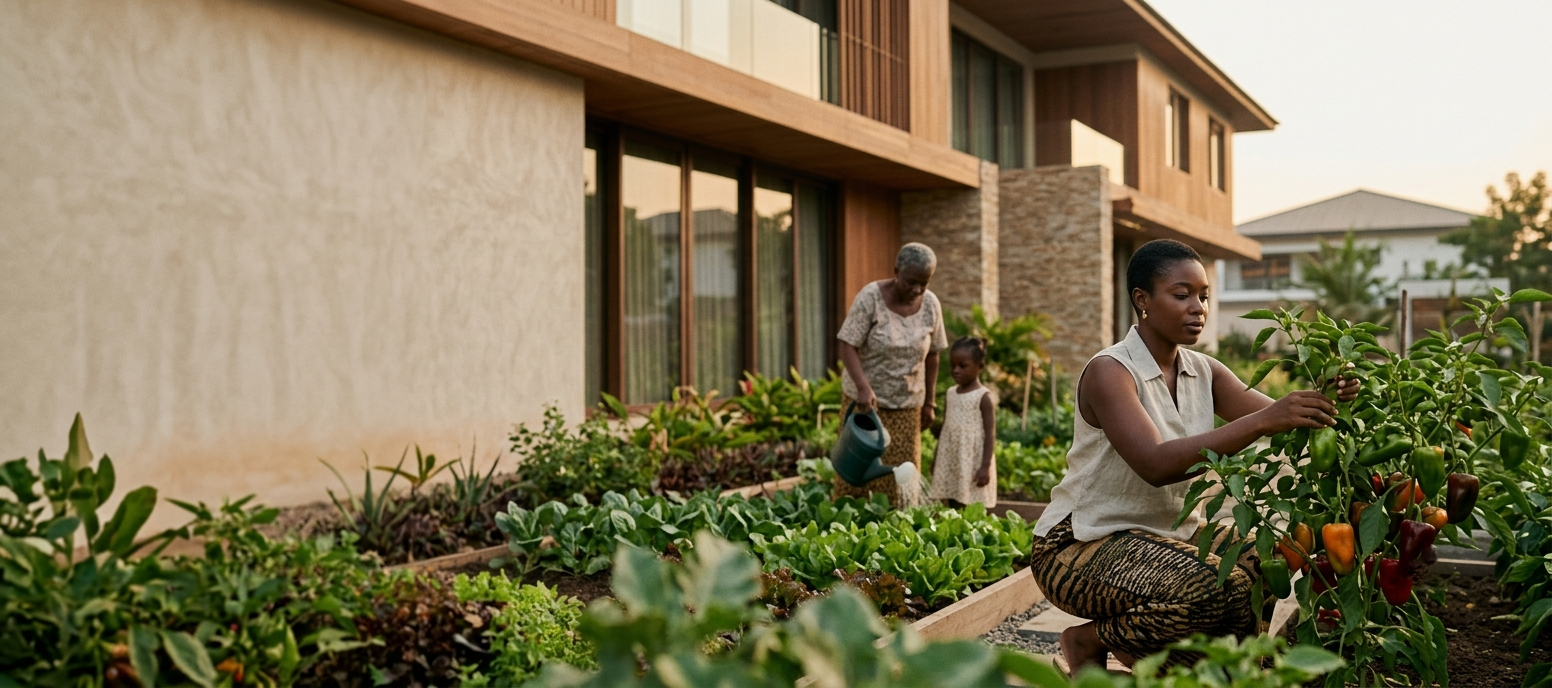
There are branches where everything appears to be happening at once. One pepper has turned red. Another is still green. Another is darkening slowly, almost there but not yet. A smaller one has only just begun to announce itself. They share air, light, rain, stem. They are near enough to belong to one another, but not close enough to become the same.
The Akan looked at this and saw more than a plant.
They saw a social truth.
Mako — the pepper — carries the proverb that all peppers do not ripen at the same time. It is often heard as comfort, and rightly so. Your season may not look like someone else's. Your timing may not obey the schedule imposed by comparison. You are not behind simply because another life has already changed colour in public.
That reading matters. Many people need to hear it before they can breathe.
But the proverb does not stop at consolation. It is not only interested in the unripe pepper's feelings. It asks what the branch knows. It asks what the ripe pepper understands. It asks how a living thing holds many stages without turning difference into failure.
This is where Mako becomes more demanding.
Not because it withdraws comfort, but because it widens it.
It is one thing to accept that you are still becoming. It is another to accept that everyone around you is still becoming too. The first gives you relief. The second changes how you treat people.
A family is never one season.
One person has finally learned how to say the truth without sharpening it. Another still uses silence as a wall. One sibling is ready to forgive. Another can only manage distance. A parent grows softer with age, but not always quickly enough for the child who needed that softness earlier. A child begins to see the humanity of a parent long after the parent has stopped expecting to be seen.
No one ripens together.
Not excuses.
Not endless tolerance for harm.
But a deeper literacy of timing.
To know that people develop unevenly is not to pretend every stage is safe, or wise, or easy to live beside. Green pepper is still pepper, but it is not ready to be used in the same way. Immaturity has consequences. So does impatience. The proverb does not ask you to deny either. It asks you to stop mistaking difference in season for absence of worth.
The branch holds what is ready and what is not ready yet.
It does not confuse them.
It does not discard either.
This may be one of the hardest forms of love: recognising where someone is without reducing them to it.
This may be one of the hardest forms of love: recognising where someone is without reducing them to it.
We do this poorly when we are afraid. We meet someone in an unfinished stage and decide that unfinishedness is their nature. We turn a season into an identity. He is selfish. She is careless. They are not serious. They never listen. We speak as if the person were a fixed object rather than a living thing still under weather.
Sometimes our judgement is a boundary, and we need it.
But sometimes our judgement is only impatience wearing the clothes of discernment.
Wisdom is not treating everything gently.
Wisdom is knowing what kind of care the season requires.
We do not only compare ourselves to those ahead of us.
We compare others to the version of them we wish they had already become.
Mako interrupts that reflex.
It does not say: wait forever.
It does not say: lower your standards.
It says: look at the branch correctly.
A branch is not failing because it carries different stages. It is alive because it does. Growth, when seen honestly, is almost always uneven. The same person can be mature in work and childish in love. Brave in public and evasive at home. Generous with money and ungenerous with time. Brilliant in thought and clumsy in apology.
You can be ripe in one place and green in another.
The branch makes arrogance difficult.
It also makes despair unnecessary.
Because if unevenness is natural, then becoming does not have to be rushed in order to be real. A green pepper does not become less alive because it has not turned red. Its future is not proof against its present. The branch does not say, you may belong once you are finished. It says, you belong while becoming.
This is the social intelligence Mako asks of us.
Not only self-acceptance.
Other-acceptance.
Not a vague niceness that refuses to name what is immature. A stronger patience. One that can see clearly and still remain humane. One that can say, you are not ready for this responsibility, without saying, you are not worthy of love. One that can set a boundary without turning the person beyond it into a failure. One that can offer help without making help feel like a verdict.
To tend a branch is not to make every pepper ripen.
It is to protect the conditions in which ripening can happen.
To tend a branch is not to make every pepper ripen.
A poor community humiliates them.
A shallow community tolerates them while privately waiting for them to become useful.
A wise community tends them.
It corrects without spectacle. It explains without contempt. It remembers that every capable person was once difficult in some earlier form. It refuses the cruelty of pretending that maturity arrived fully dressed.
This is not only kindness. It is continuity.
If no one tends what is still becoming, the branch loses its future.
Care and expectation are not enemies.
The best forms of love know how to hold both.
Someone's patience made room for you.
Someone's correction spared you.
Someone's confidence fed you before you had evidence of your own.
Someone looked at your green season and did not mistake it for your whole life.
Perhaps you remember them. A teacher. An aunt. A friend. A manager. A parent, if you were fortunate. A stranger who gave you one sentence at the right time. Someone who saw both what you were and what you were becoming, and did not use the distance between the two to shame you.
That is not small.
That is agriculture of the soul.
And now, whether you intended it or not, you stand somewhere on the branch with the power to do the same for someone else.
This is where Mako returns to the room you are already in.
Tomorrow you will meet someone who is not where you are. They may be younger. They may be older and still not ready. They may be brilliant in one part of life and painfully slow in another. They may frustrate you because their pace interrupts your preferred order of things.
You will have choices.
You can turn their stage into a judgement.
You can make your own ripeness a weapon.
You can perform patience while secretly keeping score.
Or you can ask a quieter question.
What kind of season are they in?
The question will not answer everything. It will not remove the need for honesty, boundaries, consequences, distance. But it may save you from the lazy cruelty of treating unfinishedness as failure. It may help you become more precise in your care. It may remind you that maturity is not proven by how far ahead you are, but by how you behave toward what is still growing near you.
Maturity is not proven by how far ahead you are, but by how you behave toward what is still growing near you.
The branch does not ask every pepper to become red at once.
It only asks that each remain held long enough to become what it is.
There comes a point in life when you realise you are still becoming, but you are no longer becoming alone. You are being watched. Held. Fed. Tested. Needed. You are learning from those above you and making weather for those beside you. Your life is part of a shared garden, and your growth is not the only growth at stake.
So when you look around and notice the unevenness, do not rush first to compare.
Look again.
This is not disorder.
This is a branch alive with many seasons.
Some already red.
Some still green.
Some only beginning.
All of them held.
Sit With This
Who near you is still becoming, and what kind of season are they in?
The green pepper.
The patient branch.
The care that does not hurry growth.
Where are you being asked to tend rather than judge? Leave it in the comments below.
