
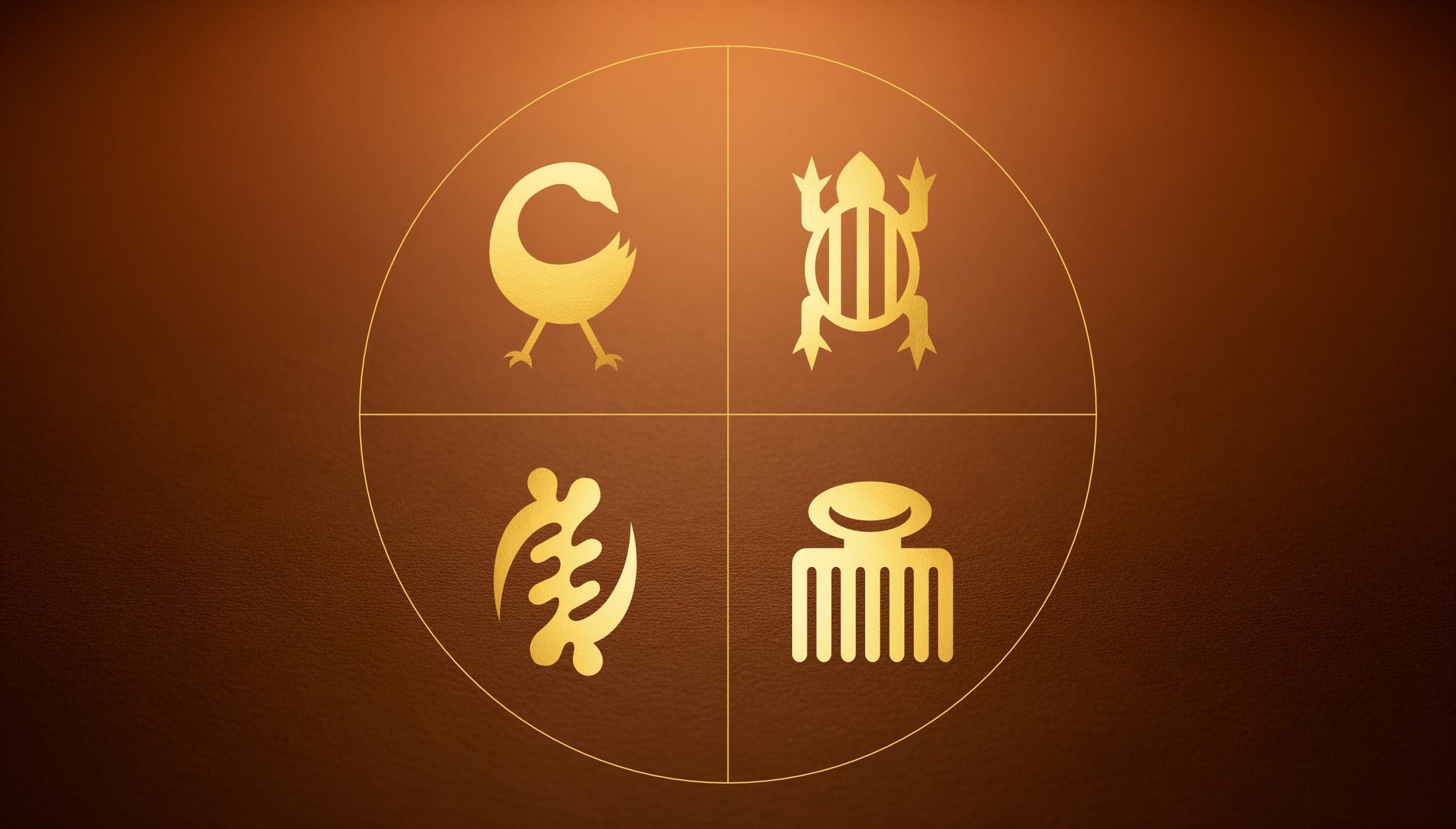
Have you ever looked at a symbol — really looked at it — and felt something shift before you could explain why? Not because you knew what it meant. Before that. Something in the shape itself, the compression of it, the sense that whatever it was carrying was older and heavier than anything you could have read about it.
If that has happened to you, you already understand something about how symbols work. And you are already, in some way, prepared for what the Akan people of Ghana built over centuries — one of the most sophisticated symbolic systems in human history.
Not a logo. Not a decorative motif. A complete thought — compressed into a mark, stamped into cloth, carried on the body as a living philosophy.
Where they came from
The word Adinkra means "farewell" or "goodbye" in Twi — a reference to the tradition's origins in funeral cloth, where symbols were stamped in dark ink onto fabric worn during mourning. To wear Adinkra was to send someone off. To say: I see what you meant. I will carry it forward.
This origin matters more than it might first appear. A symbolic language that began as a language of farewell — of what you keep from someone who is gone, of what must not be lost in the transition from their world to yours — carries a particular kind of seriousness. These symbols were not made for decoration. They were made for the moments when meaning matters most.
Over time, the symbols migrated from funeral cloth into everyday life — into architecture, pottery, metalwork, and eventually clothing. Their original gravity never entirely disappeared. It simply found new occasions. To wear Adinkra became a way of announcing not just who you were, but what you believed — what you were willing to carry, what you were committed to, what question you had chosen to live inside.
To work with Adinkra now, as Afrofa does, is to work with something that has been asking hard questions for centuries. The cloth changes. The questions don't.
How they work
Each symbol has a name, a visual form, and a meaning — but the meaning is rarely simple. It is usually a paradox, a proverb, a question held in tension. The Akan did not build a symbolic language for easy ideas. They built one for the things that resist easy expression — the teachings that need to be carried in the body, worn on the cloth, stamped into the material of daily life, because they cannot be adequately captured in words alone.
Adinkra symbols don't decorate surfaces. They ask questions of the people who carry them.
Aya — the fern
Endurance
The fern grows in difficult places — in cracks and shadows, without fanfare. Its message is not triumphant. It is patient: keep going, even when no one is watching. In a culture that rewards visibility, Aya honours something quieter and harder — the endurance that happens in private, that asks for no audience, that simply continues.
Mpatapo — the knot of reconciliation
Reconciliation · Peacemaking · Pacification
One of the most complex symbols, visually and conceptually. It represents the bond that remains after a conflict has been resolved — not the absence of conflict, but the surviving connection. The knot has no beginning and no end. It acknowledges that the threads were tangled, and shows what they can become when worked through with patience and intention. A reminder that what you build after the difficult conversation can be stronger than what existed before it.
Funtumfunefu Denkyemfunefu — the Siamese crocodiles
"They share one stomach, yet they fight over food"
Two crocodiles, joined at the stomach, fighting over the same food — food that feeds them both regardless of who wins. The image is almost comic in its precision. It is a symbol of unity, of shared fate, of the absurdity of conflict between people whose wellbeing is already entangled. The Akan did not build this symbol to make people feel good about each other. They built it to make people see clearly. That is a different kind of teaching — and a more effective one.
Why they still matter
Adinkra was never just Ghanaian. It was always human. The values it encodes — humility, resilience, the importance of community, the need to look back honestly, the weight of divine presence, the power of restraint — are not culturally specific. They are the things every human culture has had to figure out. The Akan's particular contribution was to find precise, beautiful, durable images for them.
That precision is what survives. You can look at Gye Nyame and feel its claim without being told what it means. You can look at Sankofa — the bird flying forward with its head turned back, egg in its beak — and understand, before anyone explains it, that it is carrying something important from where it has been toward where it is going.
And this matters urgently right now — not as heritage, not as aesthetic, but as a form of thinking the current moment desperately needs. We live in a culture that produces information faster than wisdom, that moves too quickly to sit with paradox, that would rather replace an idea than work through it. The Adinkra tradition does the opposite. It compresses centuries of careful thought into a single mark and asks you to carry it — to wear it, to live inside the question it poses, to let it do its slow work on you.
That is what a true symbol does. It doesn't need translation. It doesn't need explaining. It just needs to be seen — and worn by someone willing to live up to what it carries.
Is there a symbol that already feels like yours?
Sometimes people find a symbol before they can explain why. They see it and something settles — a recognition, a quiet yes. We're curious which one does that for you, and whether you knew what it meant before or after.
Leave it in the comments. And if you want to explore all 73 symbols — their names, origins, and full meanings — our Adinkra Symbols Hub is the place to start.