
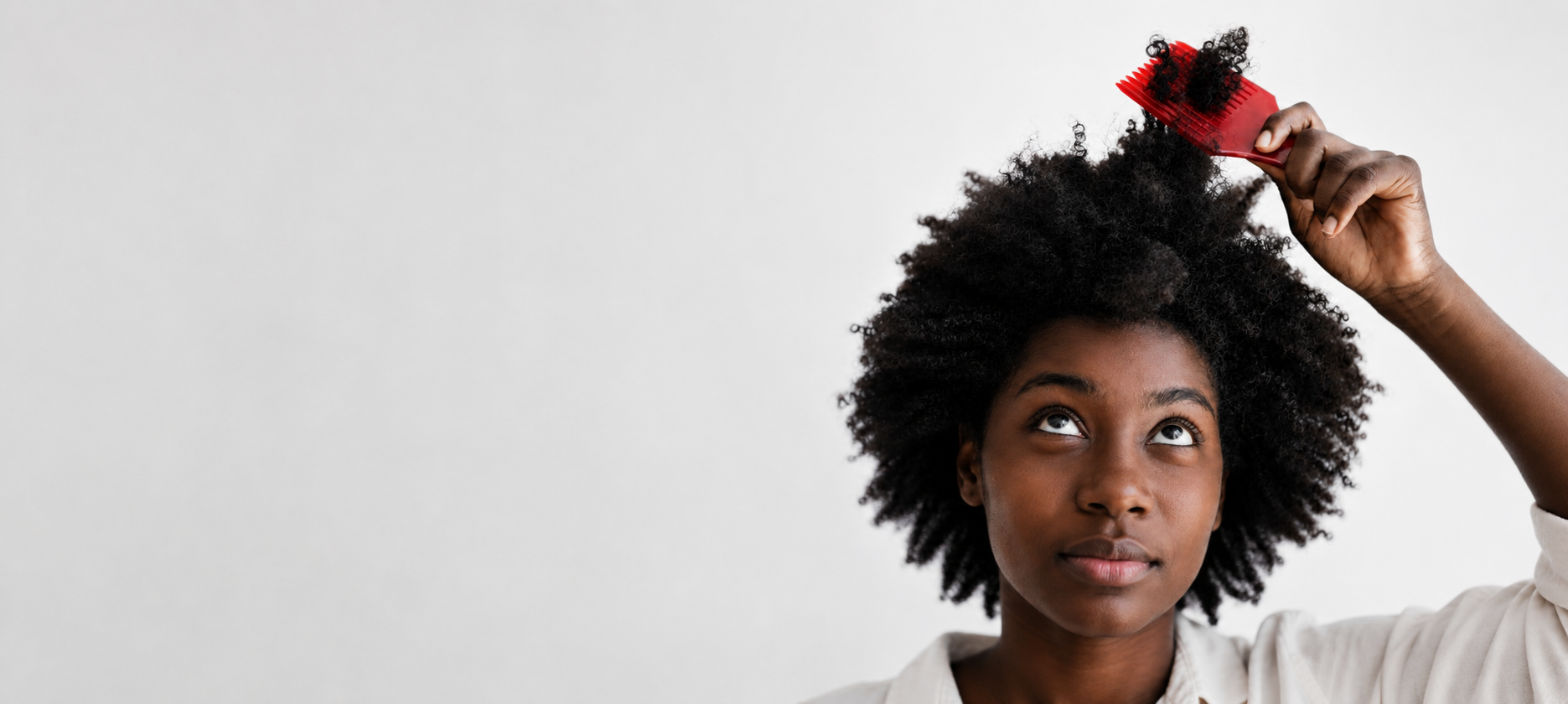
When did you last truly tend to yourself? Not the scheduled version — the face mask, the gym class, the thing you booked because you were supposed to. But the quieter kind. The unhurried hour that belonged entirely to you. The moment of returning to yourself without an audience, without a reason, without it needing to look like anything from the outside.
If you're struggling to remember, you're not alone. Most of us have replaced the practice of tending with the performance of it — and somewhere in that swap, lost something we didn't notice we were losing.
The Akan encoded the difference in a wooden comb. Small, practical, held in the hand. And carrying one of the most quietly radical teachings in the entire Adinkra canon.
The object that became a philosophy
Duafe
Pronounced doo-AH-feh · The wooden comb · Beauty · Femininity · The discipline of tending to yourself
The symbol depicts a carved wooden comb — the kind Akan women have used for centuries to care for their hair. At its most literal, it is a tool. But in Akan tradition, the act it represents became a symbol for something far larger: beauty, femininity, patience, and the quality of care we extend to ourselves and to the people around us.
The choice was deliberate. To care for your hair, in Akan culture, was not vanity — it was practice. The act of tending to yourself slowly, attentively, without rushing, was understood as training for the way you would tend to everything else. Your relationships. Your home. Your community. Your inner life. The comb was the daily reminder that attention itself is a discipline — and that the quality of the attention you bring to small things shapes the quality of the attention you bring to everything.
In Akan tradition, Duafe was associated with the virtues considered central to womanhood — not as a limitation, but as a map. Patience, because nothing worth tending can be rushed. Cleanliness, because care requires honesty about what is actually there. Beauty, understood not as appearance but as the visible result of being well looked after.
Self-care, in the Akan sense, was never about indulgence. It was about the quality of attention you brought to what mattered — beginning with yourself.
The difference between tending and performing
Here is the distinction Duafe makes that gets lost in almost every modern conversation about self-care: tending is something you do for yourself. Performing is something you do for an audience.
The wellness industry — one of the largest on earth — has become extraordinarily good at monetising the performance. The routine that looks beautiful documented. The purchase that signals you value yourself. The practice adopted because it is the thing people like you are supposed to do. None of this is wrong, exactly. But none of it is what Duafe is pointing at.
The Akan women who used the wooden comb were not tending themselves for an audience. There was no documentation, no aspiration, no signal being sent. There was a woman, a comb, and the quiet unhurried act of returning to herself. That returning — private, purposeful, and entirely her own — is what the symbol honours.
The question Duafe asks is not: are you practising self-care? It is: are you actually returning to yourself — or performing the return while remaining, underneath it all, as absent as ever?
That distinction is worth sitting with. Because the performance of tending can actually make it harder to notice how little of the real thing is happening.
The knowledge that travels through hands
Duafe is also a symbol of feminine lineage — the wisdom that passes between grandmothers and daughters and granddaughters, carried not in books but in practice. In presence. In the specific and irreplaceable knowledge that lives in the hands and the body and the unhurried hours spent together.
How to care for a body
The techniques passed hand to hand — how to braid, how to tend skin, how to move through the rituals of care that keep a person grounded in their own body. This is ancient knowledge, and in cultures that have experienced displacement and rupture, its survival is itself an act of resistance.
How to hold someone who is hurting
Not the therapeutic script, not the careful management of another person's emotions from a safe distance — but the older and harder skill of simply being fully present with someone in pain. This too is Duafe knowledge. Passed quietly. Learned by being held before you learned to hold.
How to make a room feel safer
The way certain women laugh — and make everyone around them feel like they're allowed to laugh too. The way certain women listen — and make you feel, genuinely, that what you're saying matters. The way a home is kept, a meal is made, a gathering held so that the people in it feel tended. This is not small work. It is some of the most valuable work human culture has ever produced.
None of this travels through institutions. It travels through presence — through the hours spent close enough to someone who knows, watching, absorbing, being shaped by the quality of their attention. Duafe gives this knowledge a name and a form. A small carved object that says: what you carry is worth carrying. And worth passing on.
Why Duafe is the symbol this moment needs
We are living through a particular kind of exhaustion — one that is hard to name because it coexists with a great deal of activity. People are busy tending to everything except themselves. Giving their attention constantly, generously, and at considerable personal cost — to work, to family, to the endless demands of being visible and responsive and available — and finding, somewhere in the middle of all of it, that they have very little left.
At the same time, an industry has grown up to sell the solution — and the solution it sells is designed to be purchased, documented, and repeated. It is the performance of restoration rather than restoration itself. And many people can feel the difference, even if they can't quite name it.
Duafe names it. And it points not toward the next purchase but toward the oldest and most available practice: returning to yourself, unhurried, without an audience, with the same quality of attention you would bring to someone you deeply love.
This matters. You matter. Tend yourself accordingly — not for the photograph, not for the routine, not for anyone watching. For the same reason the Akan woman picked up the comb: because you are worth the attention.