

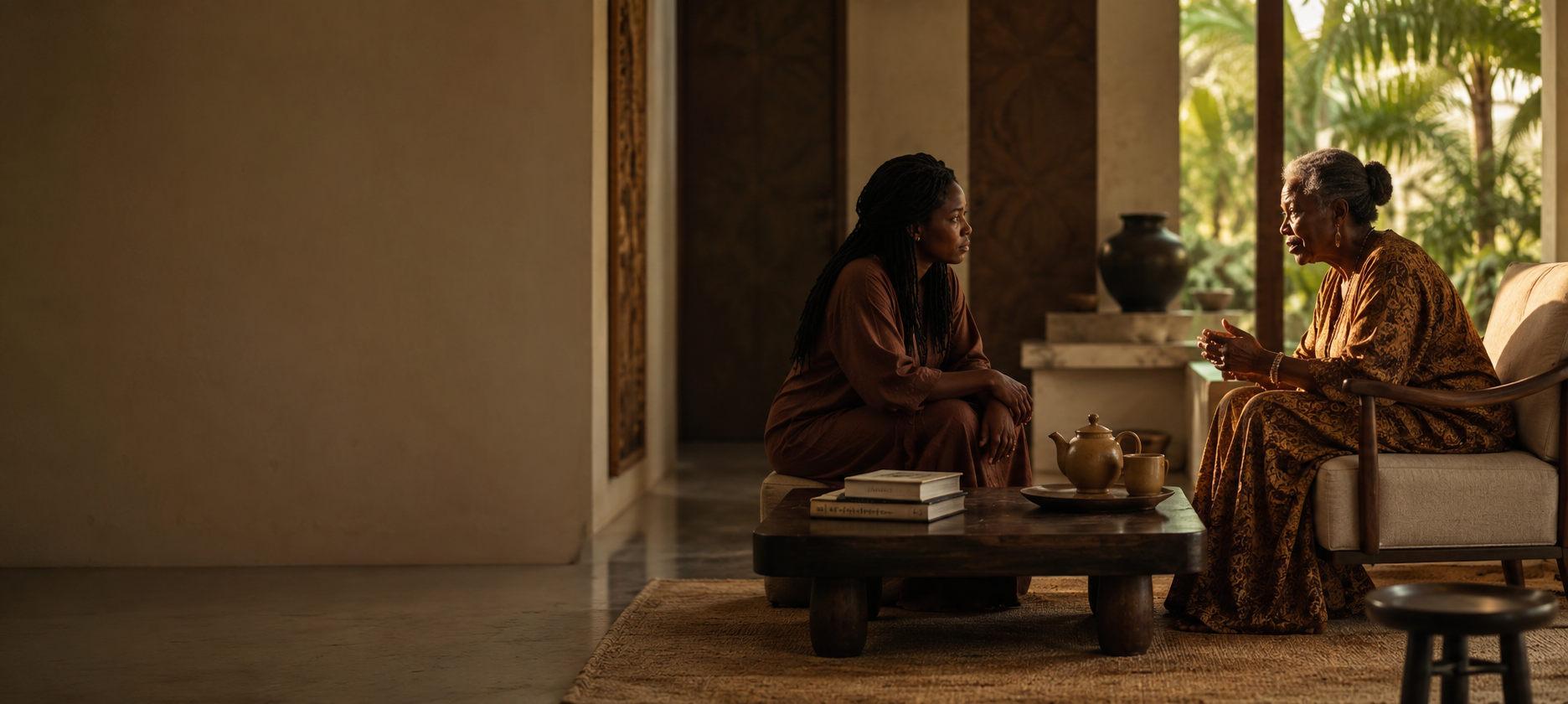
There are sentences that outlive the people who first spoke them.
Nobody remembers the exact day they were born. No one can say who first looked at a child, a storm, a quarrel, a mistake, a field, a stubborn hope, and shaped what they had seen into a sentence small enough to carry. Yet generations later, the sentence arrives again. In a kitchen. At a funeral. During an argument. On the walk home after something has gone wrong.
It waits inside the family until someone needs it.
You may have one like that. A saying from a parent. A line from a grandparent. Something an elder used to repeat so often it became part of the furniture of childhood, ignored precisely because it was always there. Then years later, in a moment nobody could have predicted, it returns with the force of a key finding its lock.
A proverb does not solve your life. It waits until your life becomes ready to understand it.
The Akan call them mpanyinsem: the words of the elders.
Not slogans. Not decorative wisdom. Not the polished captions of a culture explaining itself to strangers. Proverbs belong to use. They are spoken across thresholds, in ceremonies, in moments of correction, in the middle of ordinary conversation when a longer explanation would be less precise. They do not rush to clarify themselves. They trust time to do some of the work.
What follows is not a list, exactly.
Think of it as a small catalogue of inheritances. Seven rooms. Seven sentences that have carried more life than their size suggests. Enter each one slowly. Let it look back at you.
Exhibit I
“If an animal bites you, you learn to be cautious.”
Aboa bi beka wo a, na w’ani nsa.
This is not a proverb about fear. It is a proverb about attention after pain.
The bite matters, but it is not the whole teaching. The deeper question is whether experience changes the quality of your looking. There are warning signs in relationships, in work, in trust, in the small unease that visits before the full damage arrives. Sometimes the wound becomes useful only when it teaches the eyes to become awake.
There is no cruelty in the saying. It does not mock the bitten person. It simply assumes that pain, if honoured properly, can become perception.
Not every wound is wisdom. But every wound asks whether you are willing to learn how it arrived.
Exhibit II
“If it will rain, it will rain.”
Sɛ ɛbɛtɔ a, ɛbɛtɔ.
Some wisdom is simply the end of negotiation.
The rain does not consult your calendar. It does not become less wet because you worried about it for three weeks. It does not admire your ability to imagine every possible inconvenience before it arrives. If it will rain, it will rain.
This is not resignation. Resignation lies down before life. This proverb stands up, looks at the sky clearly, and stops spending energy where energy has no authority. The question is not whether the rain can be argued out of coming. The question is whether you will waste the whole morning fighting clouds.
Peace often begins when control finally admits the border of its country.
Exhibit III
“Wisdom is like a baobab tree; no one person can embrace it.”
Nyansa ne dua korɔ; obi nko ara ntumi nsɔ mu.
The baobab does not ask to be impressive. It simply is.
Ancient, wide, rooted beyond the scale of one pair of arms. Stand beside it and the body receives a useful correction. You are not nothing. But you are not large enough to hold everything either.
This proverb is a mercy for anyone who has been taught to perform certainty. No one person can embrace wisdom. No single mind, elder, expert, founder, parent, teacher or genius can carry the whole tree. At best, each of us holds a portion of shade for a while, then passes on what we can before moving away.
Humility is not the opposite of intelligence. It is the condition that allows intelligence to keep learning.
The wisest people tend to speak as though the tree is still larger than their arms.
Exhibit IV
“The child who is not embraced by the village will burn it down to feel its warmth.”
Abofra a ne kuro mma no nkyekyere no, ɔbɛhye kuro no.
Some proverbs arrive like a hand on the shoulder. This one arrives like a door opening in a room that has been pretending not to hear what is outside.
It is not interested in blame first. It is interested in consequence. Belonging withheld does not disappear. It changes form. A person left cold for long enough will begin to search for heat wherever heat can be found, even if the only way to feel it is through fire.
The proverb asks something of the village before it asks anything of the child. Who has been left at the edge? Who is visible enough to be judged but not close enough to be held? Who are we calling dangerous now because we refused to call them ours when it still mattered?
It is one of the clearest arguments for care because it refuses to sentimentalise neglect.
A community eventually meets the shape of what it failed to embrace.
Exhibit V
“It is the stranger who sees the snake first.”
Ɔhɔho na ɔbɛhu ɔwɔ kan.
Familiarity has its own kind of blindness.
Walk the same path long enough and the eyes begin to save energy. They stop reporting what the mind believes it already knows. The danger becomes part of the scenery. So does the beauty. So does the question nobody asks because everyone has been trained by repetition to step around it.
Then a stranger arrives and sees the snake.
This is not an insult to insiders. It is an invitation to stay humble before new eyes. The person who has just arrived may not understand everything, but they may notice what everyone else has learned to ignore. They have not yet been educated into silence. They still ask the question before the question becomes impolite.
Sometimes the freshest wisdom belongs to the person who has not yet learned what not to notice.
Exhibit VI
“A single broomstick breaks easily. A bunch does not.”
Wɔbo aboa baako a, ɔbɛpa; nanso wɔbo aboa bebree a, ɔnsesa.
Some truths are so obvious that human beings spend centuries failing to practise them.
One broomstick breaks. A bundle resists. The image is simple because the lesson has no need to be clever. Separation makes fragile what togetherness could have strengthened.
And still, again and again, we allow ourselves to be separated. By pride. By suspicion. By the old wound nobody wants to name. By systems that understand exactly how much easier it is to bend isolated people. By the fantasy that needing others is an embarrassment rather than one of the basic conditions of being human.
The broomstick does not choose loneliness. It is removed from the bundle.
That is the quieter question inside the proverb: what is doing the separating?
Unity is not a feeling. It is a structure that makes people harder to break.
Exhibit VII
“Do not look where you fell, but where you slipped.”
Nhwɛ baabi a w’atu, hwɛ baabi a w’asorɔ.
The fall is loud.
It gathers witnesses. It leaves marks. It invites explanation, embarrassment, repair. After failure, most of us become experts in the fall: how bad it was, who saw it, what it cost, how to stand again with some dignity still intact.
But the slip is where the information lives.
The condition before the collapse. The small ignored warning. The uneven ground. The assumption that went unchecked. The conversation avoided until it became an explosion. The compromise that seemed harmless because the consequence had not yet arrived.
This proverb teaches a discipline many people resist: do not merely recover from the result. Study the cause. Not to punish yourself, but to stop confusing getting up with understanding what made you fall.
Failure becomes useful only when it sends your attention back to the place where the ground changed.
A proverb is small because it is meant to travel.
It can move from an elder’s mouth to a child’s memory, from a courtyard to a ceremony, from a difficult conversation to a piece of cloth, from a family saying to a design worn by someone who may not yet know all the life inside it. It survives by being used. Every time it is spoken, it becomes old and new at once.
This is why the tradition matters now.
We live in a culture that moves quickly and forgets with impressive efficiency. The proverb moves differently. It does not explain itself completely. It does not empty its meaning on first contact. It stays with you, sometimes for years, until experience opens the part of it that advice could not reach.
At Afrofa, these sayings are not decoration. They are part of the living ground from which the work grows. Each design carries more than form. It carries a way of seeing, a memory of people who watched life carefully enough to leave language behind for those who would come after.
Somewhere, another proverb is waiting. Perhaps your grandmother said it. Perhaps a teacher did. Perhaps it came from a neighbour, an uncle, a friend’s mother, someone you did not know well enough to realise they were giving you something permanent.
Perhaps you understood it at once.
More likely, you are still growing towards it.
Wisdom often arrives before understanding does.
Sit With This
Which saying has been waiting for your life to catch up with it?
The line an elder kept repeating.
The sentence you dismissed as a child.
The wisdom that became true only after you had lived long enough.
Leave it in the comments below.